EN · Language
EnglishDeutschFrançaisItalianoEspañol

Everyday stories nin / shinobu

Recommend a story without giving away its best surprise

Describe the premise and your reading experience, then ask how much your friend wants to know. A good recommendation can leave room for discovery.

Wear this character

Start with a scene

You have finished a novel or film and want a friend to understand why it stayed with you. Your most exciting example may also reveal the central surprise. Before describing that scene, ask whether they prefer only a premise or are happy to hear more. “No spoilers” can mean different things, so a small agreement is clearer than assuming you share the same boundary.

A closer look

Share the invitation, not the reveal

Build the recommendation from three parts: the starting situation, the kind of experience you had and the person it might suit. You could say that a small mystery unfolds through ordinary conversations, that you enjoyed piecing together the clues, and that it reminded you of another work your friend liked. Avoid hinting that a particular character or object becomes important later.

Distinguish your response from a promise about theirs. “I liked the slow opening” is more useful than “you will definitely love it”. If they ask about a specific concern, answer as clearly as you can within the level of detail they want. Preserving a twist is less important than letting someone make an informed choice about what they watch or read.

See it in words

忍
nin / shinobuThe character behind these words
忍耐
nintaiEndurance or patience
忍者
ninjaNinja
Examples of usage, not a diagram of the character’s historical development.

A meaning to make your own

A thought to give

Pair a 忍 design with a short, spoiler-free reading invitation for a friend who enjoys stories. Let the book or film remain a choice, rather than assigning it as homework attached to the gift.

Make a gift card

One more question

What if we have both finished the story?

Then agree that the conversation can include the ending, while considering anyone else listening. In a public post, separate detailed discussion clearly. You can be enthusiastic and specific once the people taking part know what will be revealed.

A character to carry with you 忍

忍 can provide a personal connection with restraint: keeping one exciting detail to yourself so another person can discover it. This is a playful association with the character, not a claim about a special Japanese storytelling rule.

Wear this character
忍

忍

Share this story

More about this character 忍

All stories →

Meaning & background

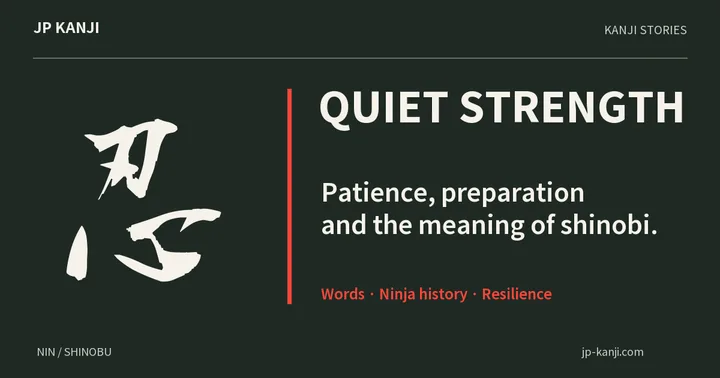
忍: endurance, ninja and the appeal of quiet strength

忍 appears in words about endurance and ninja. Learn what it says, what a familiar visual mnemonic leaves out, and how to choose it thoughtfully.

Read the story

Everyday stories

Untangle a craft cord one crossing at a time

Spread an ordinary loose cord on a clear surface and identify the next movable crossing. Patience becomes a sequence of small, visible decisions.

Read the story

Everyday stories

Before helping a maker, watch what they are trying to do

A useful offer begins with a question. Give someone room to try a small task, then agree whether they want a hint, a demonstration or another pair of hands.

Read the story

Everyday stories

Sort a mixed craft box without making it an all-day project

Choose one tray, use observable categories and keep an unknown section. A bounded sorting task can make the next making session easier.

Read the story
13 more stories

Everyday stories

Make room for everyone’s turn at the game table

Follow the play, prepare your own possibilities and ask before offering advice. The time between turns can belong to the game without belonging to your decisions.

Read the story

Everyday stories

A final check before printing words that matter

Review wording, letterforms and placement separately before approving a small print project. Keep the approved version easy to identify.

Read the story

Style & making

Hide a small detail in a drawing for someone to discover later

Add a visual secret that rewards a second look without confusing the main picture. Choose its location, scale and intended audience.

Read the story

Everyday stories

Before you reply to a difficult message

Make room between reading a frustrating message and answering it. Identify the practical question, draft a response and choose when to send it.

Read the story

Everyday stories

Quiet strength can include saying no

A clear, ordinary boundary can protect the time and care you want to give. Patience does not require endless availability.

Read the story

Sayings & idioms

Kanninbukuro: the Japanese idiom for patience running out

A bag, a cord and a sudden break: 堪忍袋の緒が切れる gives the limits of patience a vivid form.

Read the story

Everyday stories

The work that makes a small performance look effortless

Labels, checked cues and a ready room rarely take the spotlight. Notice the preparation that lets other people begin.

Read the story

Style & making

Waiting is sometimes part of making

A painted model or glued paper shape can need time between actions. Make the pause intentional rather than filling it with more adjustments.

Read the story

Culture & objects

Beyond the costume: asking what historical ninja actually did

Begin with duties and sources rather than a single dramatic image. Information gathering offers one documented part of a much wider subject.

Read the story

Everyday stories

A rehearsal for the moments between the main actions

The pause, entrance and handover can need attention too. Practise a small transition so everyone knows what happens next.

Read the story

Everyday stories

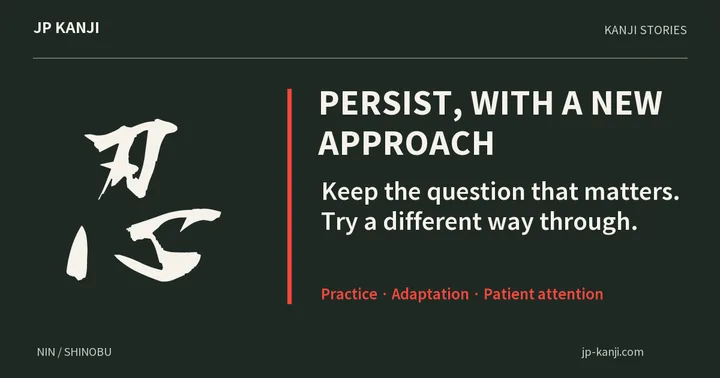
Staying with a project can include changing the method

Repeating the same attempt is not the only form of persistence. Keep the aim visible while testing a different approach.

Read the story

Words & readings

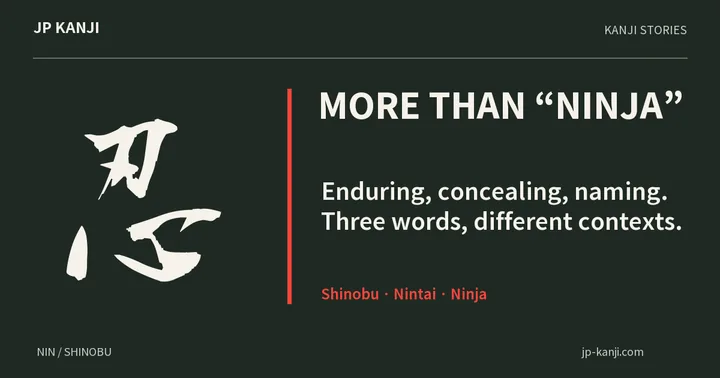
Shinobu, nintai and ninja: what 忍 changes with context

Enduring, concealing and the word ninja share a character, but they do not say the same thing.

Read the story

Giving & choosing

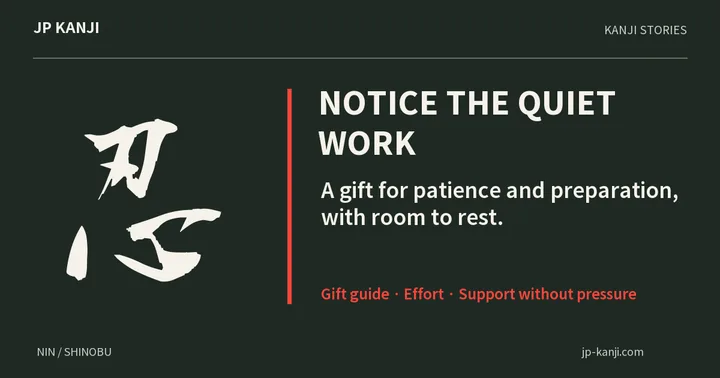
A 忍 gift for quiet effort, without saying “just endure it”

Recognise practice and preparation while leaving room for limits, rest and asking for help.

Read the story

Another character, another perspective

All stories →

Everyday stories

Why an unfinished story can stay with you

An open ending leaves a question active. Explore the difference between a deliberate invitation and a missing piece of information.

Read the story

Everyday stories

Turn a remembered dream into a four-panel comic

Keep one strange transition from a dream and build four simple panels around it. Clear shapes can carry a scene without polished drawing.

Read the story

Culture & objects

Hatsuyume: reading a New Year dream as an image, not a forecast

Fuji, a hawk and an aubergine make an unexpected trio. A museum print offers a way into Japan’s first-dream imagery.

Read the story