EN · Language
EnglishDeutschFrançaisItalianoEspañol

Style & making nin / shinobu

Hide a small detail in a drawing for someone to discover later

Add a visual secret that rewards a second look without confusing the main picture. Choose its location, scale and intended audience.

Wear this character

Start with a scene

You are drawing a street, a room or an imaginary garden. Somewhere in the scene, a tiny familiar object could make a friend smile. Decide what the main picture should show before adding the hidden detail. A drawing of a busy kitchen should still read as a kitchen even if the viewer never spots the little moon on one of the cups.

A closer look

Let the picture work before the secret is found

Give the detail a reason to belong in its location. A repeated leaf shape might conceal a small creature; a shelf might hold an object connected with a shared joke. Keep the outline clear enough to recognise once it is noticed. If the secret depends on making every surrounding shape equally confusing, simplify the background before making the hidden part even smaller.

Test the drawing at the size it will actually be seen. A detail that is visible while you zoom in may vanish in a postcard or on a phone. Show it to someone who is comfortable giving feedback and ask what catches their eye. You can offer a gentle clue later. Avoid building the joke around private information or an image the recipient would not want others to see.

See it in words

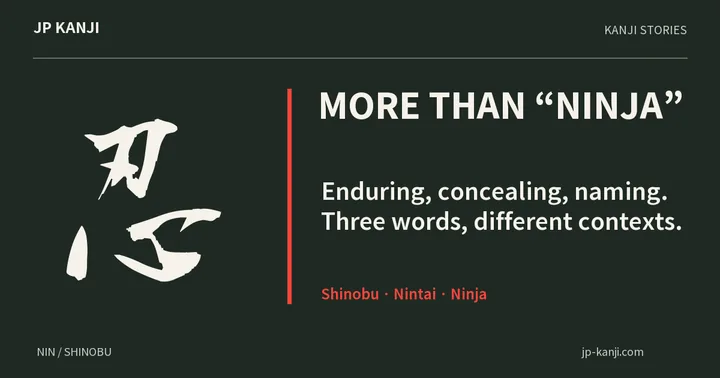
忍
nin / shinobuThe character behind these words
忍耐
nintaiEndurance or patience
忍者
ninjaNinja
Examples of usage, not a diagram of the character’s historical development.

A meaning to make your own

A thought to give

A 忍 gift could accompany the drawing with one small clue: “There is something familiar on the shelf.” Let the recipient discover it at their own pace instead of turning the gift into a test they must solve in front of everyone.

Make a gift card

One more question

What if nobody notices the hidden detail?

The main image can still succeed. If discovery matters, increase the detail’s size, strengthen one edge or offer a clue. If it is simply a private pleasure in making, it does not need to become obvious to every viewer.

A character to carry with you 忍

忍 appears in contexts involving concealment as well as endurance. This drawing exercise connects with the idea of something kept out of immediate view. It is a personal visual association, rather than a claim that hidden-picture games come from ninja traditions.

Wear this character
忍

忍

Share this story

More about this character 忍

All stories →

Meaning & background

忍: endurance, ninja and the appeal of quiet strength

忍 appears in words about endurance and ninja. Learn what it says, what a familiar visual mnemonic leaves out, and how to choose it thoughtfully.

Read the story

Everyday stories

A final check before printing words that matter

Review wording, letterforms and placement separately before approving a small print project. Keep the approved version easy to identify.

Read the story

Everyday stories

Before you reply to a difficult message

Make room between reading a frustrating message and answering it. Identify the practical question, draft a response and choose when to send it.

Read the story

Everyday stories

Quiet strength can include saying no

A clear, ordinary boundary can protect the time and care you want to give. Patience does not require endless availability.

Read the story
8 more stories

Sayings & idioms

Kanninbukuro: the Japanese idiom for patience running out

A bag, a cord and a sudden break: 堪忍袋の緒が切れる gives the limits of patience a vivid form.

Read the story

Everyday stories

The work that makes a small performance look effortless

Labels, checked cues and a ready room rarely take the spotlight. Notice the preparation that lets other people begin.

Read the story

Style & making

Waiting is sometimes part of making

A painted model or glued paper shape can need time between actions. Make the pause intentional rather than filling it with more adjustments.

Read the story

Culture & objects

Beyond the costume: asking what historical ninja actually did

Begin with duties and sources rather than a single dramatic image. Information gathering offers one documented part of a much wider subject.

Read the story

Everyday stories

A rehearsal for the moments between the main actions

The pause, entrance and handover can need attention too. Practise a small transition so everyone knows what happens next.

Read the story

Everyday stories

Staying with a project can include changing the method

Repeating the same attempt is not the only form of persistence. Keep the aim visible while testing a different approach.

Read the story

Words & readings

Shinobu, nintai and ninja: what 忍 changes with context

Enduring, concealing and the word ninja share a character, but they do not say the same thing.

Read the story

Giving & choosing

A 忍 gift for quiet effort, without saying “just endure it”

Recognise practice and preparation while leaving room for limits, rest and asking for help.

Read the story

Another character, another perspective

All stories →

Style & making

One photo, three crops: a small exercise in seeing

Use a photograph you already have to explore edges, empty space and what deserves attention—without taking another picture.

Read the story

Style & making

A still life made from three things already on your table

A cup, a folded cloth and a piece of fruit can become an exercise in attention. Change the arrangement before searching for better objects.

Read the story

Style & making

Why bold lettering needs room around it

Try a simple framing exercise with a dense character: the blank area can change how clearly you see the whole design.

Read the story