JP KANJI / Kanji stories
A character. A story worth carrying.
Everyday stories, meanings, sayings and gifts. Find a question that speaks to you.
345 stories
No stories match these choices.
龍 Dragon
34 stories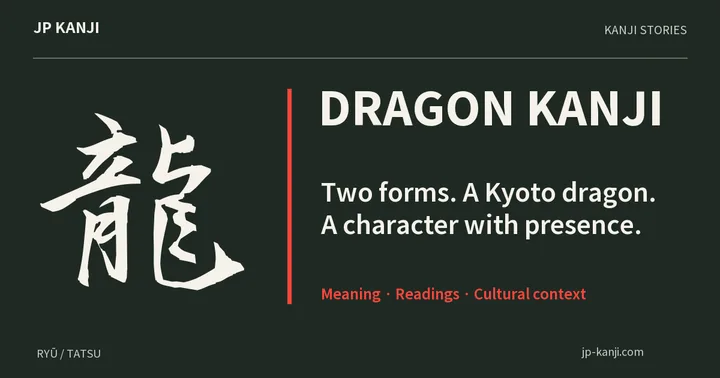
Meaning & background
Dragon kanji: 龍, 竜 and the presence of a single character
龍 means dragon. Discover its relationship with 竜, a dragon painted on a Kyoto temple ceiling, and a personal way to wear the character.
Read the story
Words & readings
Ryū or tatsu? How to read the Japanese dragon kanji
Learn the reading with the word: a dragon, a dinosaur and a tornado offer three useful starting points.
Read the story
Giving & choosing
A dragon kanji gift for someone who loves a bold design
Choose 龍 for the person’s taste, then turn a familiar fantasy motif into a personal message.
Read the story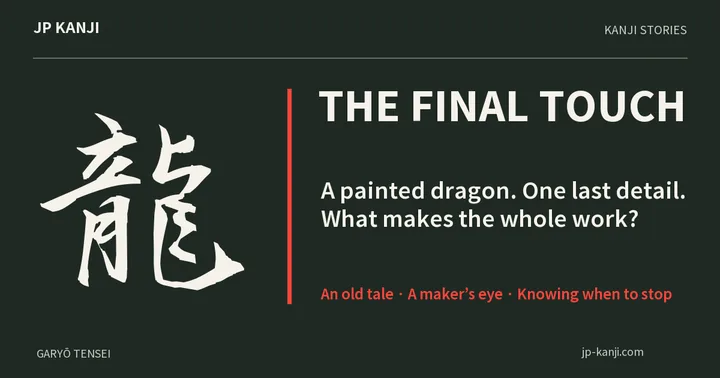
Sayings & idioms
Garyō tensei: the dragon and the finishing touch
Why would a painted dragon need one final detail? Explore 画竜点睛 and the difference between finishing a piece and adding more to it.
Read the story
Culture & objects
Why a Japanese dragon can bring rain, not fire
A dragon beside water opens a different story from the familiar fire-breathing monster. Start with the word ryūjin, then look again.
Read the story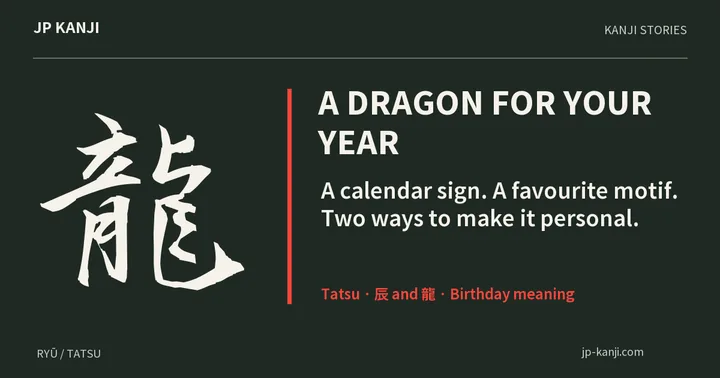
Culture & objects
Tatsu, 辰 and 龍: choosing a dragon for a birth-year connection
A calendar and a dragon print may use different characters. Here is how to keep a personal birth-year gift clear.
Read the story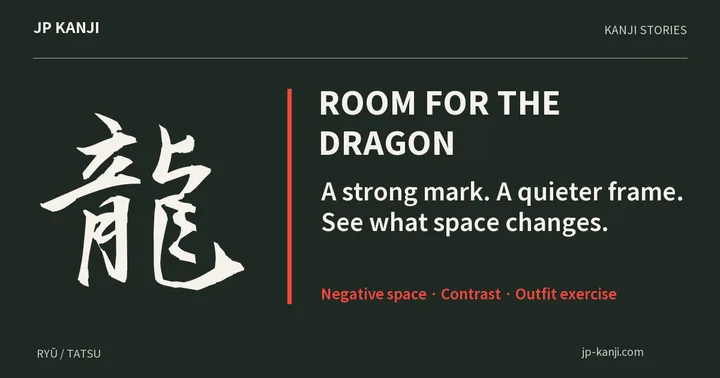
Style & making
Why bold lettering needs room around it
Try a simple framing exercise with a dense character: the blank area can change how clearly you see the whole design.
Read the story
Everyday stories
Showing your work for the first time, without a grand announcement
One print on a table and one useful question can make a first showing feel concrete. The dragon comes at the end of the story.
Read the story
Style & making
How to build an outfit around one bold graphic
Start with clothes you already wear. Compare layers, texture and contrast before adding more statement pieces.
Read the story
Everyday stories
Quiet confidence: what to say when you enter a new room
A practical way to introduce yourself without performing a louder version of your personality—and a dragon to carry the thought.
Read the story
Everyday stories
What does your kanji shirt say? A simple answer that feels like you
Explain a Japanese character in three steps: its meaning, its reading and the reason you chose it. A conversation can stay short and accurate.
Read the story
Style & making
Choosing a brush-lettered kanji shirt: look beyond the silhouette
Look at the character, its small spaces and its place on the garment before choosing a brush-lettered design. Three views can answer different questions.
Read the story
Everyday stories
Invent a dragon character with something more interesting than power
Give a fictional dragon a desire, a limitation and a habit. Use an ordinary encounter to discover what your character actually does.
Read the story
Everyday stories
Make a paper dragon that comes alive as a shadow
Turn a simple cut-out, a lamp and a blank wall into a tiny performance. Let the outline do the work.
Read the story
Everyday stories
Make a tiny paper dragon look enormous in a photograph
Use camera position and everyday surroundings to explore apparent size. Keep the creature the same while changing its relationship to the scene.
Read the story
Everyday stories
Build a dragon from packaging that suggests its own shape
Let a fold become a neck and a torn edge become a mane. Make a small creature by responding to the materials already on your table.
Read the story
Everyday stories
Write an artwork label that gives a viewer somewhere to begin
Describe one visible decision, name the material and keep your personal interpretation distinct. A small label can invite looking without dictating it.
Read the story
Everyday stories
Design a personal emblem for a sketchbook or project box
Choose a small visual rule and make a mark that belongs to a particular activity. It need not summarise your whole identity.
Read the story
Style & making
Dragon kanji T-shirt or dragon illustration: which design suits you?
A dragon drawn as a creature and the character 龍 create different impressions. Compare what each puts on the shirt before choosing a dragon gift or an everyday graphic.
Read the story
Giving & choosing
Gifts for a fantasy reader who already owns the books
Choose a gift around how someone enjoys imaginary worlds, without guessing which volume is missing.
Read the story
Style & making
What to wear to a convention when you are not cosplaying
Build a comfortable convention outfit around one interest, with room for queues, bags and the journey home.
Read the story
Style & making
How to wear an open shirt over a graphic T-shirt
Check the opening, sleeve comfort and hem lengths so the graphic remains part of the outfit.
Read the story
Everyday stories
Style a reading shelf without making the books hard to reach
Give a small bookshelf a focal point while keeping favourite volumes easy to take out and return.
Read the story
Style & making
Choosing a frame for an art print: measure before choosing the colour
Separate the image size, paper size and frame opening before buying a frame for a favourite print.
Read the story
Everyday stories
Start a fantasy book club with a first meeting people can join
Choose a manageable reading boundary and questions that welcome different kinds of readers.
Read the story
Everyday stories
Going to a book signing: what to check before packing your favourite copy
Confirm the event format, permitted books and practical details before joining the queue.
Read the story
Style & making
Make a fantasy map legend that explains how your world works
Give a few symbols clear jobs before filling an imaginary map with decorative detail.
Read the story
Style & making
Photograph a graphic T-shirt while someone is wearing it
Show the person and the print together without changing the garment to improve the picture.
Read the story
Everyday stories
Host a book swap with clear rules for the books left at the end
Make ownership, condition and the final destination of unclaimed books clear before guests arrive.
Read the story
Everyday stories
Introduce a roleplaying character without reading out a biography
Give the table an action, a useful detail and a reason to join in.
Read the story
Style & making
Design a personal bookplate before printing a whole sheet
Test a name, a small emblem and the real space inside the book.
Read the story
Everyday stories
Make a reading bingo card that leaves room for your own taste
Use nine invitations to read instead of a shopping list of compulsory books.
Read the story
Style & making
Where to put enamel pins when your T-shirt already has a graphic
Try the arrangement on paper before making holes in clothing.
Read the story
Style & making
Make a simple photo background for a fantasy miniature
Use a curved paper backdrop to keep the figure readable.
Read the story夢 Dream
35 stories
Meaning & background
夢: the Japanese kanji for dreams, hopes and possibility
A dream can happen while you sleep or belong to a future you imagine. Explore 夢 through language, poetry and the thought of encouraging someone.
Read the story
Words & readings
Yume, muchū and musō: Japanese words for dreams and imagination
A dream, being absorbed in something, and imagining possibilities are related ideas, not interchangeable translations.
Read the story
Giving & choosing
A meaningful gift to encourage someone’s dreams: choosing 夢
For a new idea, a graduation or a creative restart: recognise what matters to them without demanding a result.
Read the story
Sayings & idioms
The same trip, different expectations: what are we imagining?
Two friends look forward to the same weekend, but picture different days. An everyday conversation leads to the expression 同床異夢.
Read the story
Culture & objects
Hatsuyume: reading a New Year dream as an image, not a forecast
Fuji, a hawk and an aubergine make an unexpected trio. A museum print offers a way into Japan’s first-dream imagery.
Read the story
Everyday stories
A notebook for ideas that are not ready yet
Catch a colour, a phrase or an unfinished question without turning every page into a project plan.
Read the story
Style & making
Make a small version of the idea you keep describing
A paper mock-up can answer one question that another long explanation cannot. Decide what you need to learn first.
Read the story
Everyday stories
Returning to an old idea without returning to an old deadline
An unfinished story in a drawer may still interest you. Begin by finding what matters now, rather than recreating the original plan.
Read the story
Everyday stories
Why an unfinished story can stay with you
An open ending leaves a question active. Explore the difference between a deliberate invitation and a missing piece of information.
Read the story
Everyday stories
How to ask for feedback before your idea is finished
Make an unfinished idea easier to discuss with one useful question, a small sample and a clear next decision.
Read the story
Everyday stories
A creative hobby does not have to become a side hustle
Decide what you want from a creative pastime before turning it into orders, posts or a second job. Leave room for making things just because you enjoy it.
Read the story
Everyday stories
Turn a crowded inspiration folder into a mood board you can use
Choose a small set of references for one creative question. Add reasons, keep source links and make the next experiment clear.
Read the story
Everyday stories
Turn a remembered dream into a four-panel comic
Keep one strange transition from a dream and build four simple panels around it. Clear shapes can carry a scene without polished drawing.
Read the story
Everyday stories
Write a postcard from an ordinary afternoon you would like to have
Imagine the small details of a possible future day, then ask which details actually matter to you. Keep the exercise separate from a promise or deadline.
Read the story
Everyday stories
Draw a room with one impossible rule
Invent a space where one ordinary relationship changes. Use the rule consistently enough that a visitor can explore your imagined room.
Read the story
Everyday stories
Use a homemade prompt lottery to invent an unexpected idea
Pair an ordinary object with an action by chance. Treat the result as a short creative game, not a test of originality.
Read the story
Everyday stories
Write two futures for one small fictional decision
Branch an original scene at a clear choice and follow both consequences. Change the action while keeping the opening facts steady.
Read the story
Everyday stories
Make a one-evening exhibition of ideas you never had to finish
Give a few unrealized ideas a temporary place on a shelf. Celebrate their interest without turning the display into a promise to complete them.
Read the story
Giving & choosing
A kanji graduation gift: choose between dreams, progress and a new path
Compare 夢, 進 and 道 for a graduation gift, with messages that celebrate the graduate without choosing their future for them.
Read the story
Giving & choosing
Gifts for someone who loves writing: choose around their real habits
A useful writer’s gift starts with how they write, not a stereotype of an author’s desk. Compare familiar tools, a wanted book, time together and a personal design.
Read the story
Everyday stories
Plan a creative afternoon on your own without buying a new hobby
Choose one place, one small activity and a comfortable stopping point for time spent following your curiosity.
Read the story
Style & making
Start a reading journal without writing a review of every book
Keep the details you will want later: what you read, where an idea appears and what stayed with you.
Read the story
Giving & choosing
Make a birthday wish list that gives people useful choices
Share specific preferences, varied prices and non-object ideas without turning the list into an obligation.
Read the story
Everyday stories
A bookshop date with conversation built into the browsing
Use a few light prompts to explore each other’s tastes without turning the visit into a test or a shopping challenge.
Read the story
Giving & choosing
A gift for someone starting a hobby: buy the next useful thing
Check what the beginner wants to try before buying a large kit, specialist tool or ongoing subscription.
Read the story
Style & making
What to put on the first page of a new sketchbook
Use the opening page to learn about the paper instead of making it your best drawing.
Read the story
Style & making
Make a one-minute audio story from a place you imagine
Build a short spoken scene around one change the listener can follow.
Read the story
Giving & choosing
Giving a creative class as a gift: leave the date and difficulty open
Check the real booking conditions before presenting an experience someone has to schedule.
Read the story
Style & making
Make a two-sided bookmark with a different small scene on each side
Keep the construction flat and test it in a spare book before giving it away.
Read the story
Everyday stories
Write a short creative bio when you are just beginning
Describe what you make and what interests you without inventing a professional history.
Read the story
Style & making
Plan a short film with a six-shot storyboard
Turn one small event into a sequence you can actually film.
Read the story
Style & making
Write an imaginary café menu that suggests a whole world
Use a few names, descriptions and consistent details to build a fictional place.
Read the story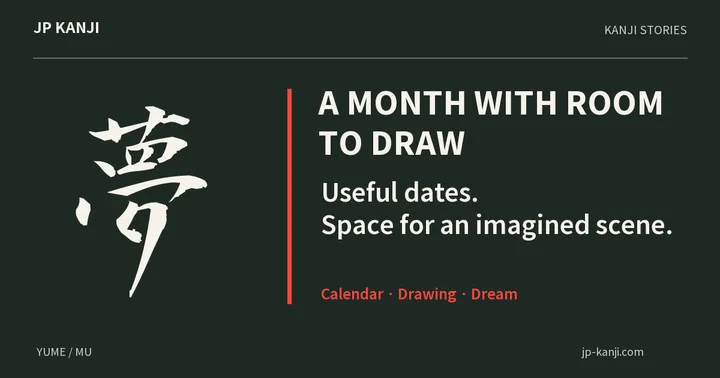
Style & making
Make an illustrated calendar for one month without filling every square
Keep the dates useful and give the drawing a separate place to breathe.
Read the story
Style & making
Design a playlist cover that still reads at thumbnail size
Choose one visual idea and test it where listeners will actually see it.
Read the story
Everyday stories
Plan an indoor treasure hunt with clues people can actually follow
Test the route, the hiding places and the final reveal before inviting players.
Read the story和 Harmony
36 stories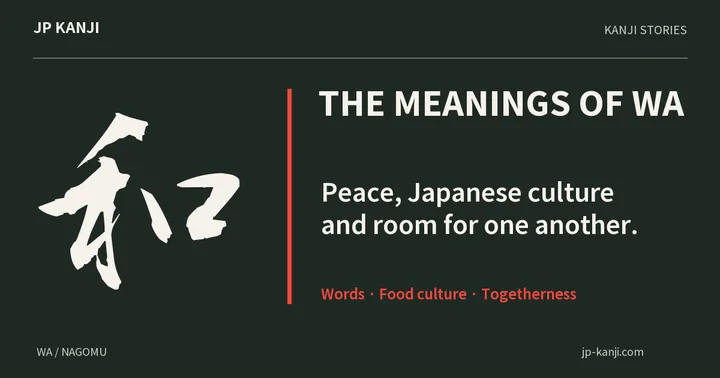
Meaning & background
和: harmony, Japanese culture and room for one another
和 appears in words for peace, harmony and Japanese food. See how context changes its meaning and how it can become a thoughtful gift.
Read the story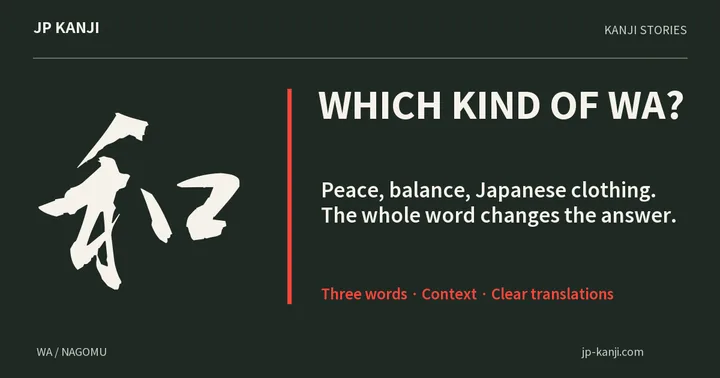
Words & readings
Wa in context: peace, harmony and Japanese clothing
Compare heiwa, chōwa and wafuku to see why 和 cannot always be translated as “peace”.
Read the story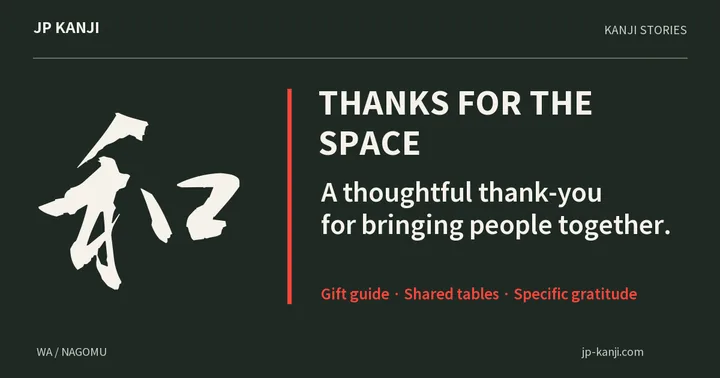
Giving & choosing
A thank-you gift for someone who brings people together: choosing 和
Recognise a host, teammate or friend through one specific moment of care, without asking them to keep everyone happy.
Read the story
Sayings & idioms
Getting along without agreeing on everything
A shared aim can leave room for different tastes. An everyday discussion leads to 和して同ぜず and the idea of keeping your own voice.
Read the story
Culture & objects
What makes a shared meal feel shared?
Preparing, passing and clearing can matter as much as the menu. Washoku offers a cultural starting point for noticing those connections.
Read the story
Style & making
A small colour palette that still feels like you
Try two colours and one accent using clothes or objects you already own. Harmony can include a deliberate difference.
Read the story
Everyday stories
Making room for the quieter person in a conversation
A welcoming gathering needs more than extra chairs. Small changes can make it easier for different people to join in.
Read the story
Everyday stories
Why the quieter part matters in an ensemble
A melody may stand out while another part makes it possible. Use a simple listening exercise to notice the work around the centre.
Read the story
Everyday stories
When a shared plan changes: making the new version clear
A changed time or cancelled contribution can leave people imagining different plans. Write the next agreement in plain language.
Read the story
Everyday stories
Sharing a space without needing the same habits
A small agreement about desks, noise and shared objects can make room for different ways of living.
Read the story
Style & making
Coordinated outfits without wearing the same clothes
Plan an outfit together around one shared detail while keeping your own colours, cuts and comfort. A practical idea for friends, partners or a group photo.
Read the story
Everyday stories
Plan a small clothing swap where nobody feels obliged to take something
Make a clothing swap easier with clear expectations, honest condition notes and a plan for items that do not find a new owner.
Read the story
Everyday stories
Write credits for a shared creative project before you forget the details
Make the work around a finished project visible: agree on names, describe contributions and check the credit line together before publication.
Read the story
Everyday stories
Start a board-game evening with a practice turn, not a test
Make the first round understandable and agree on the practical rules before competition begins. Different levels of experience can share the same table.
Read the story
Everyday stories
Make a two-person playlist that leaves room for both tastes
Alternate a few song choices for an ordinary listening session. The aim is to share attention, not to prove whose music belongs in the room.
Read the story
Everyday stories
Set up a shared creative toolkit people can actually return things to
Give each tool a clear home and make unfinished use visible. A small borrowing system can prevent the repeated mystery of the missing scissors.
Read the story
Everyday stories
Write a shared event caption without speaking for everyone
Separate the facts from personal reactions, then check names and images together. A group memory does not need a single compulsory voice.
Read the story
Everyday stories
Make one small invitation work in two languages
Give the practical information equal visibility and ask a reader to check each version. A welcoming invitation begins with details people can actually use.
Read the story
Style & making
Kanji T-shirt, sweatshirt or hoodie: how to choose the garment
Compare a T-shirt, crewneck sweatshirt, pullover hoodie and zip hoodie for a kanji design. Start with how you will wear it, then inspect the exact product.
Read the story
Giving & choosing
Housewarming gifts for a small home: thoughtful ideas without extra clutter
When space is limited, a useful housewarming gift starts with a question. Compare a shared meal, a specific offer of help and an item the recipient has actually asked for.
Read the story
Giving & choosing
How to organise a small gift exchange with a clear budget and useful wish lists
Agree on participation, spending, timing and preferences before assigning names. A practical plan for a small Secret Santa or another one-gift-per-person exchange.
Read the story
Everyday stories
Plan a potluck with a dish list that prevents five identical desserts
Coordinate contributions, serving space and kitchen time before everyone starts cooking.
Read the story
Everyday stories
Choose a film together without spending the evening scrolling
Use a small shortlist, a time limit and a clear tie-breaker to reach a choice everyone can accept.
Read the story
Everyday stories
Prepare for an overnight guest when you do not have a spare room
Make sleeping space, belongings and the morning routine clear before your guest arrives.
Read the story
Style & making
Make a party guestbook people can fill in without a speech
Offer a short prompt, an easy writing surface and a place for contributions to dry or stay together.
Read the story
Everyday stories
Keep a shared calendar for friends without sharing your whole life
Record agreed plans, owners and changes while keeping personal schedules private.
Read the story
Everyday stories
Plan an online hobby meetup that gives everyone a way to join
A small agenda, clear access details and optional participation make a first online gathering easier.
Read the story
Everyday stories
Writing a bring-a-friend invitation without creating awkward surprises
Explain guest numbers, practical limits and introductions before an informal gathering grows.
Read the story
Giving & choosing
Organise a group gift without pressuring everyone to spend the same
Agree on the total, contribution privacy and what happens if the plan changes.
Read the story
Everyday stories
Label a shared fridge so ownership and shared food are easy to understand
Use a few agreed labels instead of filling the fridge with ambiguous notes.
Read the story
Everyday stories
Make room for quiet and conversation at a small gathering
Give guests a choice of atmosphere without dividing them into fixed personality types.
Read the story
Everyday stories
Set up a shared photo album without losing track of permission
Agree who can add, view and reuse pictures before inviting the group.
Read the story
Style & making
Organise a community noticeboard people can scan quickly
Separate the purpose, the date and the next action on every notice.
Read the story
Everyday stories
Make a simple sign-out sheet for things friends borrow
Record the item, the return plan and a useful condition note.
Read the story
Style & making
Write a story together without undoing the previous person's scene
Agree on a small world and pass on a useful unfinished question.
Read the story
Everyday stories
Choose a recipe-swap format that other people can follow
Keep the original note, your changes and unanswered questions distinct.
Read the story愛 Love
35 stories
Meaning & background
愛 and 恋: choosing the Japanese kanji for love
愛 is a character for love and care. Compare it with 恋, then find a way to give the design without relying on an unexplained symbol.
Read the story
Words & readings
Japanese words for love beyond romance: aijō, aiyō and aichaku
Three words with 愛 reveal affection, favourite everyday objects and attachment built over time.
Read the story
Giving & choosing
A Japanese love-symbol gift for a friend, parent or partner: choosing 愛
Keep the same character and change the note: three ways to make a gift’s intention clear.
Read the story
Sayings & idioms
Keiten aijin: the Japanese maxim about reverence and care for others
Making room for someone or letting them finish a thought: small gestures open a conversation about 敬天愛人 and a surviving work of calligraphy.
Read the story
Everyday stories
Why everyday objects become favourites: usefulness, habit and memory
A familiar cup, notebook or garment can hold a history of use. Find the detail that makes one ordinary object matter.
Read the story
Everyday stories
How to write a thank-you that could only be for one person
Name an action, its effect and the memory you kept. A few specific lines can carry more than a grand declaration.
Read the story
Everyday stories
Keeping a faraway friend in the ordinary parts of your life
A photograph of a familiar corner or a short postcard can offer something to share without demanding an immediate reply.
Read the story
Everyday stories
The handwritten recipe that holds more than ingredients
A margin note or a familiar abbreviation can preserve a person’s way of explaining. Keep the practical details and the memory together.
Read the story
Everyday stories
The small rituals that make an ordinary day feel shared
A cup set out or a familiar goodbye can mean something because of the people involved. Find out which gestures are actually welcome.
Read the story
Everyday stories
A thoughtful gift starts with a detail you noticed
Move beyond guessing a personality: use a remembered preference to choose a gift that fits someone’s actual life.
Read the story
Everyday stories
A birthday gift for someone who dislikes surprises
Make a birthday feel considered without a secret plan. Agree on the practical details and leave a small, personal part of the gift for the day itself.
Read the story
Everyday stories
Lending a favourite object without leaving the important things unsaid
A book, jacket or small tool can carry personal meaning. Agree on its use and return so that sharing does not depend on guesswork.
Read the story
Giving & choosing
Give clothing with room for a different size or colour
Choose a clothing gift without making the recipient defend their fit or taste. Agree on the useful details and leave a clear route for a change.
Read the story
Everyday stories
One photograph, two memories: write a caption together without agreeing on everything
Make a private keepsake from one shared photograph and two independent captions. Different memories can stay different on the same page.
Read the story
Everyday stories
Offer useful help without making a friend organise it all
Turn a vague offer into two practical choices, with a clear time and an easy way to decline. Start with what your friend actually wants.
Read the story
Everyday stories
Recommend a favourite book without giving your friend homework
Explain the connection behind a recommendation, offer a small starting point and leave space for a different response.
Read the story
Giving & choosing
Turn a running joke into a tiny book for two
Give a shared joke four illustrated pages: an origin, a variation, a surprise and a quiet closing detail. Keep its audience small by choice.
Read the story
Everyday stories
Make a portrait with three questions instead of a camera
Invite someone to describe an ordinary pleasure, a surprising preference and a detail they want remembered. Let them shape the finished text.
Read the story
Giving & choosing
A kanji anniversary gift: 愛, 和 or 旅 for your shared story
Choose an anniversary T-shirt or sweatshirt around affection, life together or a journey you remember. Compare three characters and write a note that makes the connection clear.
Read the story
Giving & choosing
How to make a small memory box without keeping everything
Choose a few objects with clear stories, add short notes and leave room for the person who will open the box. A meaningful collection can stay small.
Read the story
Giving & choosing
Build a small care parcel around a letter, not a pile of extras
Choose a few items that make sense together and let the message explain why they are there.
Read the story
Giving & choosing
Choose a gift for a pet lover that is actually for the person
Separate the owner’s tastes from the animal’s needs before choosing a portrait, keepsake or clothing.
Read the story
Giving & choosing
An experience gift for a grandparent: choose the day together
Plan around the person’s interests, pace and practical preferences instead of treating age as a gift category.
Read the story
Everyday stories
Plan an at-home date that feels different from an ordinary evening
Change the arrangement, choose one shared activity and agree on a simple ending instead of overproducing the night.
Read the story
Giving & choosing
Before turning a photograph into a gift, check who wants it displayed
Choose the image, audience and format together when a picture contains someone else’s private moment.
Read the story
Everyday stories
Plan a birthday greeting across time zones without guessing the hour
Use the recipient’s local date and leave room for an ordinary busy day.
Read the story
Giving & choosing
Make a recorded voice message that feels like a gift, not a performance
Choose one memory, record clearly and make the message easy for the recipient to keep.
Read the story
Giving & choosing
Make a personal crossword from shared memories without making it impossible
Use fair clues, a readable grid and an answer key for a playful personal gift.
Read the story
Everyday stories
Choose a family photo location around the people who will be in it
Prioritise access, light and a workable meeting point before choosing a dramatic backdrop.
Read the story
Giving & choosing
Before giving a plant, check whether the recipient wants to care for it
Think about space, routine and household suitability before choosing a living gift.
Read the story
Giving & choosing
What to say when a thoughtful clothing gift does not fit
Thank the intention and make the practical problem easy to discuss.
Read the story
Giving & choosing
Make a matching game from personal photographs
Choose clear pairs, identical backs and pictures everyone is happy to share.
Read the story
Giving & choosing
Write letters to open later without predicting someone's life
Choose occasions the recipient can recognise and give them control over the timing.
Read the story
Style & making
Make a friendship map that shows connections rather than precise addresses
Use shared places and clear labels to tell a personal story.
Read the story
Everyday stories
Write a recipe credit note that keeps the person's story attached
Distinguish who taught you, what you changed and what you still need to ask.
Read the story風 Wind
34 stories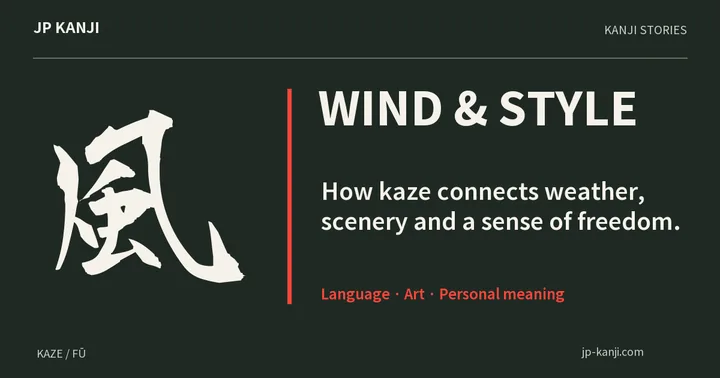
Meaning & background
風: the Japanese kanji for wind, scenery and style
Kaze means wind, but 風 also appears in words about scenery and style. Follow those connections and find a quieter way to express freedom.
Read the story
Words & readings
Kaze and fū: reading the Japanese kanji for wind and style
Follow wind into scenery and artistic style, while keeping each complete word’s meaning clear.
Read the story
Giving & choosing
A meaningful gift for an independent spirit: choosing the wind kanji 風
Choose a message of freedom that celebrates the person without telling them to leave, change or start over.
Read the story
Sayings & idioms
Fūrinkazan: why wind is only part of the picture
風林火山 puts movement beside stillness. Read its four images before turning it into a slogan about speed.
Read the story
Culture & objects
Fūrin: hearing the breeze before you notice it
A small bell makes a moving breath of air audible. Explore the object, its sound and the summer association without confusing them.
Read the story
Style & making
How to suggest wind in a still photograph
Show what the air touches: fabric, leaves or a reflection. Begin with visible evidence before inventing a story around it.
Read the story
Everyday stories
When the picnic becomes an indoor afternoon
A changed plan can preserve the part people were looking forward to. Identify that part before replacing the whole day.
Read the story
Style & making
Finding your visual style by noticing what you repeat
Collect examples you genuinely return to, then describe their common details. A personal style can emerge from choices rather than a label.
Read the story
Culture & objects
Giving the unseen a figure: thinking about wind gods in art
An invisible force can become a character in a picture. Start with a named artwork, then separate its record from your own response.
Read the story
Everyday stories
What to do with an hour you did not plan
Keep a cancelled appointment from becoming another task list: choose a small, open-ended way to spend the time.
Read the story
Style & making
Packing for one night away: choose the extra layer you will use
Build a small overnight bag around the day you expect to have, then choose one extra layer by how you will wear and carry it.
Read the story
Style & making
Try a new clothing colour with the wardrobe you already have
Test one unfamiliar colour against clothes you actually wear. Keep the experiment small and use product images to compare the exact option.
Read the story
Style & making
Make a paper mobile from offcuts and watch what the air changes
Turn spare paper into a lightweight hanging arrangement. Adjust the balance, leave space between shapes and notice how the view changes as it turns.
Read the story
Everyday stories
Draw a score for the sounds of a breeze
Use lines, gaps and repeated marks to record what you hear as air moves nearby. No musical notation or audio equipment is needed.
Read the story
Style & making
Look at how a garment moves, not only how it hangs
Try an actual garment while sitting, reaching and walking. Separate what a still photograph shows from what you can learn by wearing it.
Read the story
Everyday stories
Three tones, the same conversation: a small dialogue exercise
Keep the speakers and facts fixed, then change rhythm, pauses and sentence length. Hear how a fictional exchange takes on a different manner.
Read the story
Everyday stories
Tell one gust of wind from three different viewpoints
Keep a fictional event unchanged while limiting what each observer can know. Discover how viewpoint chooses the details of a scene.
Read the story
Everyday stories
Make a paper landscape you do not have to glue down
Move a few paper shapes through several compositions. Record the versions you like before making a final decision—or leave the landscape changeable.
Read the story
Style & making
A three-day travel capsule: plan the outfits before packing the bag
Build three days of casual outfits from clothes you already wear. Use a simple outfit grid to spot gaps, avoid duplicate extras and leave room for one favourite graphic.
Read the story
Style & making
What to wear to an outdoor concert: layers for the event and journey home
Plan clothing for the journey, the event and the return, using the forecast and the venue’s actual rules.
Read the story
Style & making
Make a clothing shopping list from the outfits that do not quite work
Identify the missing role before buying another attractive piece with nowhere to go.
Read the story
Style & making
Choosing clothing colour online: what a screen can and cannot tell you
Use consistent comparisons and the named product variant without expecting a digital image to guarantee physical colour.
Read the story
Style & making
Organise a small clothes rail without turning it into a display you cannot use
Choose what needs hanging, leave handling room and keep the everyday route clear.
Read the story
Style & making
Take a casual outfit from work to an evening out with one planned change
Check both settings, then choose a small change that fits in the bag you already carry.
Read the story
Style & making
Pair a graphic T-shirt with a skirt without losing the print
Use the waistline, shape and movement of the skirt to decide how the outfit sits.
Read the story
Style & making
How to tuck a graphic T-shirt while keeping the design readable
Test the printed area, waist comfort and ordinary movement before settling on a tuck.
Read the story
Style & making
Wear a scarf with a graphic T-shirt without covering the whole design
Choose the scarf’s placement after seeing how it sits over the printed area.
Read the story
Style & making
Mix two clothing patterns by changing one visual variable at a time
Compare scale, colour and empty space before adding a third patterned piece.
Read the story
Style & making
Choose clothes for a video call by checking the actual camera frame
Test the visible neckline, print and background before the call begins.
Read the story
Style & making
Wear a graphic T-shirt under a blazer without hiding the design
Check the neckline, the opening and the outfit in motion.
Read the story
Style & making
Build an outfit colour palette from a landscape photograph
Translate the proportions of a scene, not every colour in it.
Read the story
Style & making
Plan a small outdoor display when loose paper keeps moving
Make the table readable without relying on a perfectly still day.
Read the story
Style & making
Photograph one window at different moments to notice changing light
Keep the framing steady and let the scene provide the variation.
Read the story
Style & making
Sort a small wardrobe by the job each piece does in an outfit
Find useful combinations before deciding what is missing.
Read the story道 Way · path
34 stories
Meaning & background
道: michi, dō and the idea of finding your way
道 can be a road or a way of doing something. Explore its readings, its place in words such as jūdō, and a personal connection with practice.
Read the story
Words & readings
Michi, dōro and shodō: how 道 is read in Japanese words
A path, a road and calligraphy show the range of 道 without turning every example into a philosophy.
Read the story
Giving & choosing
A new-chapter gift that honours their path: choosing the kanji 道
For a career change, a course or a long-running practice, celebrate direction without prescribing a destination.
Read the story
Sayings & idioms
The bookshop detour: what a small pause adds to a journey
A book catches your eye on the way home. That small pause leads to 道草を食う, a vivid expression about the time we spend along the way.
Read the story
Everyday stories
Choosing between two creative projects without choosing your whole future
Two appealing ideas can become easier to compare when the decision is about the next experiment, not a permanent identity.
Read the story
Everyday stories
Seeing your familiar walk as if someone asked you to describe it
Three stops and a few concrete observations can reveal details hidden by routine, without turning an ordinary walk into a performance.
Read the story
Culture & objects
Before the first kanji: noticing what a brush can do
A few marks can help you observe width, ink and direction before trying to imitate an entire character.
Read the story
Style & making
A map of the places that matter to two people
A bench, a corner and a meeting place can make a small map more personal than a perfectly measured route.
Read the story
Culture & objects
When a practice becomes a way: more than counting sessions
A recurring activity can influence how you approach people and tasks. Keep that personal observation distinct from a discipline’s formal teaching.
Read the story
Everyday stories
Choosing a first teacher: questions worth asking
Before committing to lessons, look at how a teacher explains a first step, responds to questions and fits your purpose.
Read the story
Everyday stories
How to choose a meeting place that works for everyone
A useful meeting point needs more than a map pin. Share the entrance, the waiting spot and a simple plan for finding each other.
Read the story
Everyday stories
Build a personal reading path around a question you care about
Choose your next book by a useful question, leave a short note and follow the connection that interests you. A reading path need not become a completion list.
Read the story
Style & making
Arrange a small photo display with a clear place to begin
Choose a viewing route for a few photographs. Test the opening, the transition and the final image before attaching anything to the wall.
Read the story
Everyday stories
Write directions a first-time visitor can actually follow
Turn a familiar route into a short sequence of decisions, visible landmarks and checks. Test the words without supplying the missing steps aloud.
Read the story
Everyday stories
Design a tiny board game with a choice worth making
Draw two routes, give them different tradeoffs and test whether a player has a reason to choose either. Keep the first game small enough to revise.
Read the story
Everyday stories
Find the missing step in a simple instruction sheet
Watch a new reader follow a small making task from written instructions. Repair the point where the page assumes knowledge the reader does not have.
Read the story
Everyday stories
Draw a transit map for a town that does not exist
Invent a few destinations, connect them with clear lines and test the map using ordinary journey questions. Let the routes shape the fictional place.
Read the story
Everyday stories
Make your creative notebook easier to find things in
Build a small index from the questions you actually ask when returning to old notes. Link different names for the same useful detail.
Read the story
Everyday stories
How to choose a word of the year without making another resolution
Choose a word that helps with an ordinary decision, try it for a week and change it if it does not fit. A personal theme does not need a performance target.
Read the story
Everyday stories
Your first solo museum visit: choose a small route through a large collection
Plan a manageable visit with a few works, practical information and permission to leave before seeing everything.
Read the story
Everyday stories
Plan a themed walk with three stops, not a checklist of sights
Choose a shared question for three nearby stops and give each one a different role.
Read the story
Style & making
Write a one-page brief for a small creative project
State the audience, deliverable and limits before choosing materials or asking someone to help.
Read the story
Giving & choosing
Thank a mentor with a specific memory and an appropriate gift
Name what helped, respect the setting and avoid turning appreciation into a new request.
Read the story
Everyday stories
Starting a book series: choose a reading order without spoiling the story
Distinguish publication order, story chronology and companion books before buying a large set.
Read the story
Everyday stories
Your first fabric-shop visit: what to take before choosing a beautiful cloth
Bring the project requirements and a small list of questions before buying by appearance.
Read the story
Everyday stories
Use a museum audio guide without turning the visit into a checklist
Choose a few stops and leave time to look before listening to the next explanation.
Read the story
Everyday stories
Prepare for a first language exchange with a fair and manageable plan
Agree on time, correction preferences and a few topics you can genuinely discuss.
Read the story
Style & making
Sketch a useful floor plan for a small event before moving the furniture
Mark routes and practical needs first, then place the tables and activities.
Read the story
Everyday stories
Find something worthwhile in a used bookshop without a perfect shopping list
Use a loose search direction and inspect the copy before deciding it belongs on your shelf.
Read the story
Everyday stories
Compare two creative workshops beyond the finished sample photograph
Check the teaching, the materials and what you will do yourself.
Read the story
Style & making
Map a branching story before writing every possible ending
Make each choice change something the reader can recognise.
Read the story
Everyday stories
Visit an open studio without feeling you need to know what to ask
Use the artist's own display as a starting point for a short conversation.
Read the story
Style & making
Organise creative reference books by the questions they help answer
Find a useful source without rebuilding your entire bookshelf.
Read the story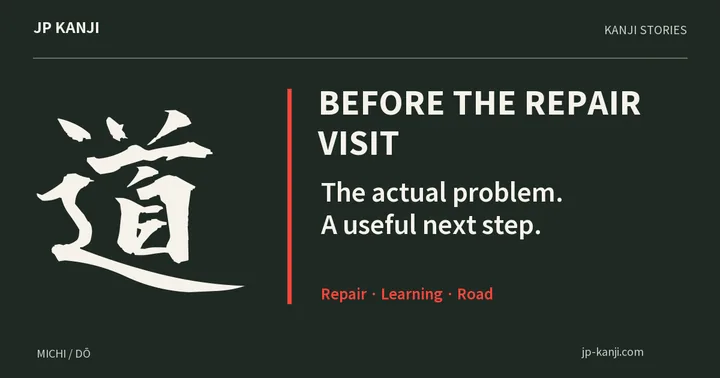
Everyday stories
Prepare for a first Repair Café visit
Check the local event and bring a clear account of the problem.
Read the story美 Beauty
35 stories
Meaning & background
美: Japanese kanji for beauty, from a character to a way of looking
Discover 美, its relationship with the word utsukushii and the hiragana み, and a personal approach to choosing a design for beauty.
Read the story
Words & readings
Bi and utsukushii: using the Japanese character for beauty
See how 美 works in an adjective, the arts and a word for virtue, without treating the kanji alone as a complete sentence.
Read the story
Giving & choosing
A gift for someone with an eye for beauty: choosing the kanji 美
For a maker, photographer or attentive friend, recognise the details they notice and the care they bring.
Read the story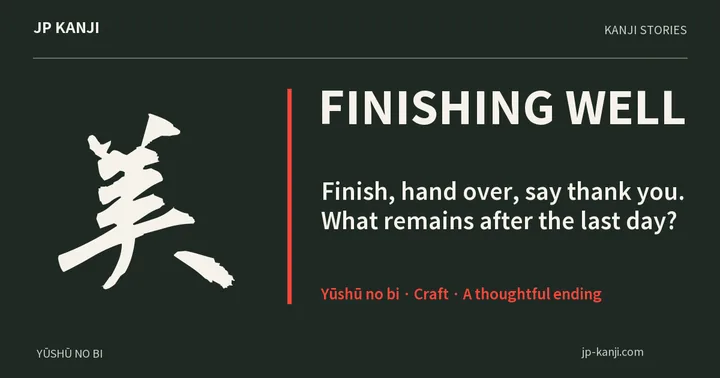
Sayings & idioms
Yūshū no bi: the Japanese expression for bringing things to a fine conclusion
After the final artwork or presentation, an impression remains. A thoughtful goodbye leads to 有終の美 and another way to think about beauty.
Read the story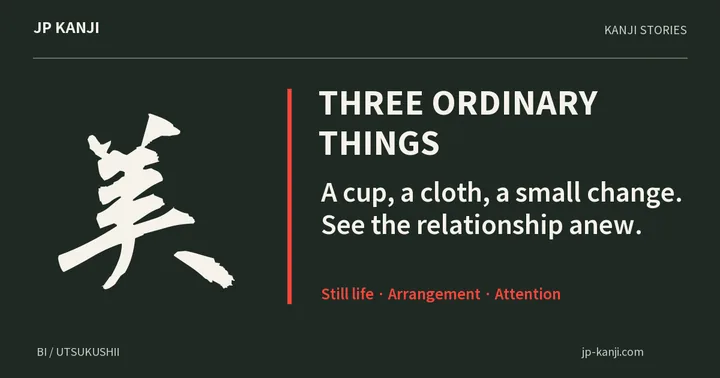
Style & making
A still life made from three things already on your table
A cup, a folded cloth and a piece of fruit can become an exercise in attention. Change the arrangement before searching for better objects.
Read the story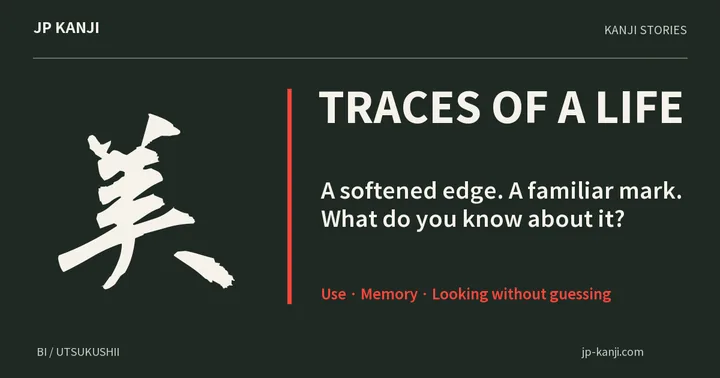
Everyday stories
When a familiar object shows its history
A softened edge or a worn handle can make use visible. Describe the trace before deciding what story it tells.
Read the story
Style & making
The beautiful detail that makes something easier to use
A clear handle or a readable label can be pleasing because it helps. Look for a specific connection between appearance and use.
Read the story
Everyday stories
Looking at the same artwork twice, with a different question
The first glance finds an impression; the second can find its cause. Try a short method for looking without needing a grand interpretation.
Read the story
Culture & objects
A tea bowl can be beautiful in more than one way
Rustic surfaces are only one part of tea ceramics. A museum account helps make room for contrast, selection and individual objects.
Read the story
Style & making
One photo, three crops: a small exercise in seeing
Use a photograph you already have to explore edges, empty space and what deserves attention—without taking another picture.
Read the story
Style & making
A visible clothing repair can become a detail you choose
Think about colour, placement and everyday use before making a repair stand out. A familiar garment can keep its usefulness and gain a personal detail.
Read the story
Style & making
Make a one-colour outfit interesting by looking at texture
Compare surfaces, shapes and a single graphic when an outfit uses similar colours. Start with the clothes already in your wardrobe.
Read the story
Everyday stories
Enjoy a small collection without needing the complete set
Give a collection a personal focus and a physical limit. Keep the details that matter, and leave room to pass on the next tempting object.
Read the story
Everyday stories
Window-light photography: compare one object at three times of day
Keep the subject and frame still while daylight changes. A small photographic study can reveal what the light contributes to an ordinary object.
Read the story
Everyday stories
Draw a familiar object from touch before you look
Explore a safe everyday object with your hands, describe its edges and make a drawing from that description. Then compare the details you noticed.
Read the story
Style & making
Make a two-colour picture from paper silhouettes
Reduce a familiar scene to outlines and gaps. Move a few paper shapes until the picture remains readable without internal detail.
Read the story
Style & making
Build a pattern from one small mark
A curve, dash or uneven dot can become a personal pattern. Compare spacing and direction before adding more shapes or colours.
Read the story
Everyday stories
Design a small label that makes a handmade notebook feel complete
Choose the first thing a reader needs to see, then give supporting details a quieter place. Test a real-size label before attaching it.
Read the story
Style & making
How to choose a kanji T-shirt size using a shirt you already own
Compare garment width and length with the right size chart, distinguish them from body measurements, and use product photos without guessing a size from the model.
Read the story
Giving & choosing
How to wrap a soft gift without a box: a neat parcel or a simple bag
Wrap a scarf, T-shirt or other soft present by giving it a stable shape first. Choose a flat parcel or a bag, then add a clear, personal finishing detail.
Read the story
Style & making
Plan a small gallery wall with paper before making holes
Test the arrangement at real size, including gaps and nearby furniture, before choosing fixings.
Read the story
Style & making
Make a table centrepiece without flowers or extra clutter
Use a few low objects while leaving room for plates, conversation and serving dishes.
Read the story
Everyday stories
Organise a dresser tray around the things you use every day
Give small everyday objects a visible place without moving the whole drawer onto the surface.
Read the story
Style & making
Caring for printed clothing: read the garment before choosing the wash
Use the actual care label and product guidance, especially when several fabrics and prints share one laundry load.
Read the story
Style & making
Photograph a clothing flat lay that shows the garment clearly
Arrange the real shape, keep the whole item in view and avoid props that hide useful details.
Read the story
Style & making
Reuse wrapping paper with folds that look intentional
Work with existing creases and clean sections before adding ribbon or another layer.
Read the story
Style & making
Make handwritten place cards guests can read from their seats
Test the name, contrast and folded shape before decorating a whole set.
Read the story
Style & making
Fold printed T-shirts so the right design is easy to find
Organise by what you need to recognise, while following each garment’s care instructions.
Read the story
Style & making
Choose a necklace that works with a graphic T-shirt’s neckline and print
Look at where the pendant actually falls rather than matching metal colour alone.
Read the story
Style & making
Bring an art print home without treating every paper like a poster
Ask about the medium and packaging before deciding whether a print can be rolled.
Read the story
Style & making
Choose a mat colour for an art print using paper trials
See how the border changes the picture before ordering a frame.
Read the story
Style & making
Place a signature on your artwork without competing with the image
Test position, scale and contrast before making a permanent mark.
Read the story
Style & making
Make a small catalogue of objects you want to remember
Record the details that matter without inventing an object's history.
Read the story
Style & making
Write an image description for your artwork that helps someone picture it
Choose the details that matter in this particular context.
Read the story
Style & making
Make a paper swatch ring before choosing material for a project
Label real samples so you can compare more than colour.
Read the story忍 Endure · conceal
34 stories
Meaning & background
忍: endurance, ninja and the appeal of quiet strength
忍 appears in words about endurance and ninja. Learn what it says, what a familiar visual mnemonic leaves out, and how to choose it thoughtfully.
Read the story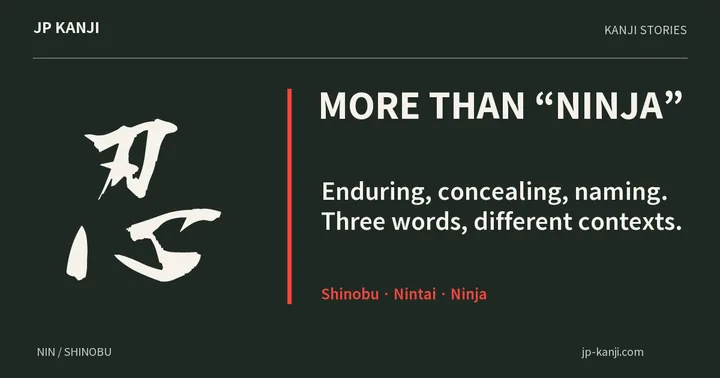
Words & readings
Shinobu, nintai and ninja: reading 忍 in Japanese words
Enduring, concealing and the word ninja share a character, but they do not say the same thing.
Read the story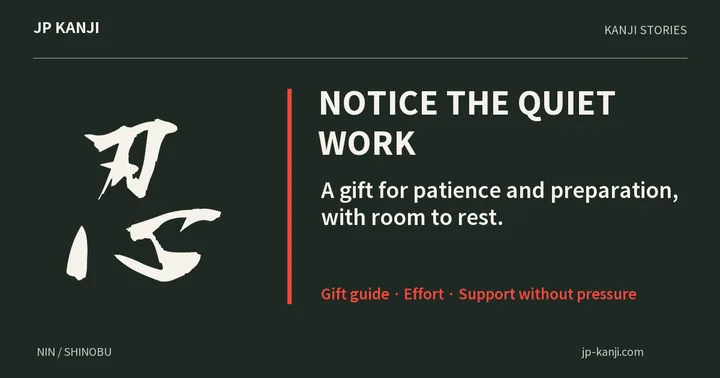
Giving & choosing
A gift to recognise quiet effort: choosing the patience kanji 忍
Recognise practice and preparation while leaving room for limits, rest and asking for help.
Read the story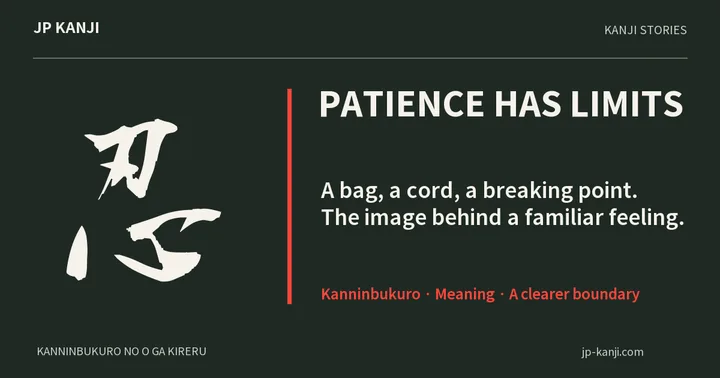
Sayings & idioms
Kanninbukuro: the Japanese idiom for patience running out
A bag, a cord and a sudden break: 堪忍袋の緒が切れる gives the limits of patience a vivid form.
Read the story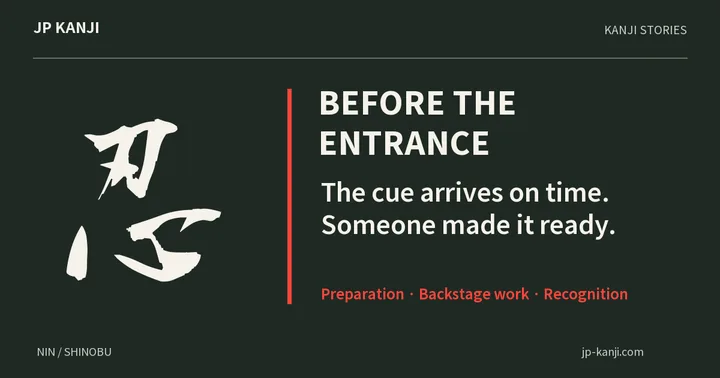
Everyday stories
The work that makes a small performance look effortless
Labels, checked cues and a ready room rarely take the spotlight. Notice the preparation that lets other people begin.
Read the story
Style & making
Waiting for paint or glue to dry: make the pause part of your craft project
A painted model or glued paper shape can need time between actions. Make the pause intentional rather than filling it with more adjustments.
Read the story
Culture & objects
Beyond the costume: asking what historical ninja actually did
Begin with duties and sources rather than a single dramatic image. Information gathering offers one documented part of a much wider subject.
Read the story
Everyday stories
A rehearsal for the moments between the main actions
The pause, entrance and handover can need attention too. Practise a small transition so everyone knows what happens next.
Read the story
Everyday stories
Staying with a project can include changing the method
Repeating the same attempt is not the only form of persistence. Keep the aim visible while testing a different approach.
Read the story
Everyday stories
Quiet strength can include saying no
A clear, ordinary boundary can protect the time and care you want to give. Patience does not require endless availability.
Read the story
Everyday stories
Before you reply to a difficult message
Make room between reading a frustrating message and answering it. Identify the practical question, draft a response and choose when to send it.
Read the story
Everyday stories
A final check before printing words that matter
Review wording, letterforms and placement separately before approving a small print project. Keep the approved version easy to identify.
Read the story
Style & making
Hide a small detail in a drawing for someone to discover later
Add a visual secret that rewards a second look without confusing the main picture. Choose its location, scale and intended audience.
Read the story
Everyday stories
Untangle a craft cord one crossing at a time
Spread an ordinary loose cord on a clear surface and identify the next movable crossing. Patience becomes a sequence of small, visible decisions.
Read the story
Everyday stories
Recommend a story without giving away its best surprise
Describe the premise and your reading experience, then ask how much your friend wants to know. A good recommendation can leave room for discovery.
Read the story
Everyday stories
Before helping a maker, watch what they are trying to do
A useful offer begins with a question. Give someone room to try a small task, then agree whether they want a hint, a demonstration or another pair of hands.
Read the story
Everyday stories
Sort a mixed craft box without making it an all-day project
Choose one tray, use observable categories and keep an unknown section. A bounded sorting task can make the next making session easier.
Read the story
Everyday stories
Make room for everyone’s turn at the game table
Follow the play, prepare your own possibilities and ask before offering advice. The time between turns can belong to the game without belonging to your decisions.
Read the story
Style & making
What to wear to an escape room: comfortable clothes, with room for the theme
Start with your venue’s guidance, then choose clothes you can move in comfortably. Use a quick outfit check and add a theme through one detail if you want to.
Read the story
Everyday stories
Set up a jigsaw session you can put away before the table is needed
Plan the working area, loose pieces and stopping point before opening the box.
Read the story
Everyday stories
Choose a quiet evening hobby for a shared apartment
Consider setup noise, light, storage and the other people using the space before choosing the activity.
Read the story
Style & making
Sort a pile of clothes to repair into a manageable mending queue
Separate simple tasks, jobs needing advice and items you no longer want before buying supplies.
Read the story
Giving & choosing
Gifts for a chess player: ask about how they actually play
Compare practical equipment, books and personal motifs without guessing their level or preferred format.
Read the story
Everyday stories
Buying a used board game: check the edition and components first
Use the correct contents list and photographs to understand what is included before agreeing to buy.
Read the story
Giving & choosing
Choose a model kit as a gift by checking tools, space and interest
Match the project to the person before being impressed by the finished model on the box.
Read the story
Style & making
Leave a crochet project with enough notes to restart it confidently
Record the exact stopping point, tools and next action before putting the work away.
Read the story
Everyday stories
Agree on phone use at a board-game table without policing everyone
Set a practical expectation that leaves room for rules, access needs and important messages.
Read the story
Style & making
Check secondhand clothing before buying it for the print
Inspect the garment’s condition and measurements as carefully as its graphic design.
Read the story
Giving & choosing
Choose a puzzle gift by matching the kind of challenge, not just its difficulty
Ask about format, space and preferred pace before buying the hardest option.
Read the story
Giving & choosing
Proofread a personalised gift order before approving the preview
Check names, layout and the exact version the maker will use.
Read the story
Everyday stories
Learn a board game from its rulebook before teaching it to friends
Build a small practice round and keep unanswered rules visible.
Read the story
Style & making
Keep a missing-parts log for a kit without losing the evidence
Record the exact reference before substituting or contacting the supplier.
Read the story
Style & making
Make a sewing practice sample before working on the real garment
Test the same layers and keep notes that explain the result.
Read the story
Style & making
Assemble a paper model without losing track of its tabs
Sort the parts and test each join before making it permanent.
Read the story旅 Journey
34 stories
Meaning & background
旅: tabi, travel and the stories you bring home
旅 is the kanji for a journey. Explore how a place can become a memory, and how to turn a travel-inspired design into a personal gift.
Read the story
Words & readings
Tabi, ryokō and tabibito: three Japanese travel words
A journey, travelling and a traveller: learn the differences without turning them into a rigid “tourist versus explorer” rule.
Read the story
Giving & choosing
A thoughtful gift for a travel companion: a memory, a note and 旅
Choose a detail from a shared journey instead of a generic list of destinations or a promise of the next trip.
Read the story
Sayings & idioms
Tabi wa michizure: a Japanese proverb about travel companions and kindness
An improvised lunch can stay with you longer than a missed train. A story of companionship leads to 旅は道連れ世は情け.
Read the story
Everyday stories
The small souvenir that remembers a whole afternoon
A ticket, postcard or sketch can carry a precise moment. Keep the memory attached before the object becomes anonymous.
Read the story
Everyday stories
Spending time on one street instead of collecting more stops
Choose a small area and a few questions. A modest outing can give you something specific to remember without a crowded itinerary.
Read the story
Style & making
A travel journal you can write in five lines
Record one place, one detail, one exchange, one surprise and one question. Keep it small enough to finish while the day is still clear.
Read the story
Everyday stories
The return journey: noticing home after being away
A familiar room can look slightly different when you return. Record the difference before ordinary routines cover it again.
Read the story
Everyday stories
Giving a travel memory to someone who was not there
A souvenir becomes easier to receive when its story connects with the recipient, not only with the traveller.
Read the story
Everyday stories
Travelling with a friend when your ideal days are different
Agree on pace, spending and time apart before a trip, so shared memories do not require an identical itinerary.
Read the story
Everyday stories
Make a travel playlist that remembers the journey in order
Turn a few songs into a personal route through a trip. Keep the connection specific with a place, a moment and one line of your own.
Read the story
Style & making
Choose souvenir clothing you will still wear after the trip
Look beyond the holiday moment when choosing a souvenir T-shirt or layer. Connect the memory to a garment that fits life at home.
Read the story
Everyday stories
Sketch a place with a few lines instead of chasing a perfect view
Choose one shape, one overlap and one detail for a travel sketch. Leave enough context to remember where you stopped and what caught your attention.
Read the story
Everyday stories
What to pack for a day trip: plan the outing, then test your bag
Walk through one outing from departure to return, then test your bag. Specific scenes can be more useful than an ever-growing generic packing list.
Read the story
Everyday stories
How to choose a train or coach seat: views, access and travelling together
A window view, easier access or sitting together may lead to different choices. Rank your preference before reading the actual train or coach seat options.
Read the story
Everyday stories
Make a small phrase card for the conversations your trip may need
Choose a few practical questions, check their intended meaning with a fluent reader and prepare a way to ask for a written answer. Keep the card easy to find.
Read the story
Everyday stories
Share a trip without making your friends watch every photograph
Choose three scenes, keep the first telling short and invite another person’s story. A travel evening can become a conversation instead of a slideshow marathon.
Read the story
Everyday stories
Read a departure board one detail at a time
Match your booking to the service information in front of you, then resolve the uncertain detail. A familiar-looking destination alone may not identify your departure.
Read the story
Giving & choosing
How to give a trip as a gift when the dates are not decided
Make the surprise an invitation to plan, with a clear offer and room to choose. Here is what to put in the card before any travel is booked.
Read the story
Giving & choosing
Plan souvenir spending before the last shop at the station
Choose who you are buying for, what is worth carrying and how much space you want to give to gifts.
Read the story
Everyday stories
Plan a day trip by train around the return journey
Choose a reachable destination, a manageable activity and a return plan checked with the actual operator.
Read the story
Style & making
Make a travel photo book people will want to turn through
Choose a small story, remove repeated views and give each page a clear role.
Read the story
Everyday stories
Plan a rainy city day without crossing town between every indoor stop
Build a compact alternative around one area and check the practical details before leaving.
Read the story
Style & making
Send a postcard from home as if someone were visiting your ordinary day
Choose one local detail and write a small scene instead of waiting for a holiday worth announcing.
Read the story
Everyday stories
Pack for a trip with two hotels without unpacking everything twice
Separate the first stay’s needs from items that can remain packed until later.
Read the story
Everyday stories
A hotel-room departure check that follows the way you used the room
Check likely storage places once in a clear order before returning the key.
Read the story
Everyday stories
Plan laundry on a longer trip before reducing your clothing list
Check access, drying time and garment care before counting on a mid-trip wash.
Read the story
Everyday stories
Share a suitcase without losing track of whose essentials are where
Agree on space, access and responsibility before putting two people’s belongings in one bag.
Read the story
Everyday stories
Return to a favourite destination without trying to repeat the same trip
Keep one familiar anchor and leave space to notice what has changed.
Read the story
Everyday stories
Make an offline arrival note before a trip
Keep the next few steps readable when your usual connection is unavailable.
Read the story
Everyday stories
Organise travel receipts before they lose their meaning
Keep a simple record of purchases, shared expenses and items you may need to check later.
Read the story
Everyday stories
Pack one small craft project for a journey
Choose a portable stage of the work and check the actual travel rules.
Read the story
Giving & choosing
Write a souvenir label that remembers where the object came from
Keep the place, the purchase and your personal memory distinct.
Read the story
Everyday stories
Use a hostel common room without assuming everyone wants company
Read the space and make a small invitation that is easy to decline.
Read the story進 Move forward
34 stories
Meaning & background
進: the Japanese kanji for moving forward, one step at a time
Learn how 進 appears in words about advancing, then find a way to make the character an encouraging reminder rather than a demand.
Read the story
Words & readings
Susumu vs susumeru: moving forward in Japanese
Two verbs built from 進 place the focus differently. Learn the distinction with a meeting and a plan.
Read the story
Giving & choosing
A gift to celebrate someone’s next step: choosing the kanji 進
Mark a launch, a return or a small achievement with encouragement that does not become a demand for speed.
Read the story
Sayings & idioms
Nisshin geppo: what the Japanese idiom for steady progress means
The expression describes continuing progress. Learn its rhythm, then distinguish a description of change from a demand to improve every day.
Read the story
Style & making
Finishing a first version that someone can respond to
A usable draft needs a clear job. Decide what it should let another person see before polishing every corner.
Read the story
Everyday stories
Practising one small skill without turning everything into a score
A narrow question can make a practice session easier to understand. Compare examples, then decide what to work on next.
Read the story
Everyday stories
Starting a hobby again after a long gap
Begin with the activity as it fits your life now. A return does not need to recreate your former schedule.
Read the story
Everyday stories
Helping the next person continue where you stopped
A useful handover explains the current state, the next action and the unresolved questions. Progress can mean making continuation easier.
Read the story
Everyday stories
Learning with a friend without turning it into a race
Two people can work on different questions and still help each other. Make the purpose of feedback clear before comparing results.
Read the story
Everyday stories
How to decide when a small project is done
Define a useful finish line before polishing forever. Progress can mean completing, handing over and making room.
Read the story
Everyday stories
Make creative progress visible with a before-and-after record
Compare two versions of your work around one specific question. A small record can show what changed without turning a hobby into a scoreboard.
Read the story
Everyday stories
Leave a restart note before putting a creative project aside
Help your future self return to an unfinished project with the current version, the open question and one clear next action.
Read the story
Everyday stories
Teach one small skill with a demonstration someone can follow
Show a clear result, slow down the difficult transition and give the learner a chance to try. A useful demonstration does not need to cover everything you know.
Read the story
Style & making
Make a paper shape move in a short stop-motion loop
A fixed camera, a paper shape and a few small movements are enough to explore animation. Plan the return to the starting point as carefully as the movement itself.
Read the story
Everyday stories
Name creative file versions so you can find the one you meant
Separate working drafts, meaningful alternatives and exported copies. A small naming rule makes it easier to return to a design without guessing which file is final.
Read the story
Style & making
Plan an eight-page zine that feels complete when you turn the last page
Choose a small subject, make a numbered paper dummy and test the reading order. An eight-page booklet gives the idea a useful boundary.
Read the story
Style & making
Turn one event notice into a layout you can use again
Separate the parts that stay from the details that change. Test a reusable layout with awkward real examples before calling it a template.
Read the story
Everyday stories
Pack a small making kit someone can use without you beside them
Prepare a paper activity for another adult with clear contents, a visible first step and a way to keep unfinished work together.
Read the story
Giving & choosing
What to write in a leaving card for a colleague: thoughtful, short examples
Write a leaving-card message with one specific thank-you and a wish that fits what you know. Use these examples for a close colleague, a team card or an uncertain next step.
Read the story
Style & making
Plan a first craft-market display at the size of the actual table
Test visibility, prices and the handover space before carrying every product to the event.
Read the story
Style & making
Film a short hands-only demonstration that someone can follow
Show the starting state, keep the important action visible and test the result with a new viewer.
Read the story
Style & making
Build a small creative portfolio around the work you want to do next
Choose relevant examples, explain your contribution and make the first few pieces easy to understand.
Read the story
Style & making
Make a reusable setup checklist that survives the second event
Record actions in the order they happen and test whether another person can use the list.
Read the story
Everyday stories
What to put in your bag for a first day at a new workplace
Use the employer’s instructions first, then pack a small set of practical items for the actual day.
Read the story
Style & making
Prepare a creative open-call submission before the deadline becomes the project
Turn the published requirements into a checklist and verify the exact files you will send.
Read the story
Style & making
Write a product description that separates facts from styling ideas
Explain what the buyer receives before describing the mood or occasion you imagine.
Read the story
Style & making
Make a materials-cost sheet for a small handmade project
Track quantities used and what remains before treating a purchase total as the cost of one item.
Read the story
Style & making
Test a small creative project with a question people can actually answer
Choose one uncertain part of the work and observe it before asking for general opinions.
Read the story
Style & making
Set up a small packing station at home without filling the room with supplies
Arrange a clear work surface and a short flow from item check to finished parcel.
Read the story
Style & making
Test a digital invitation on a phone before sending it
Check the date, the location and the action guests need to take.
Read the story
Giving & choosing
Write useful instructions for a handmade gift
Explain the first use, the limits and how to care for the actual object.
Read the story
Style & making
Turn creative feedback into a revision log you can use
Separate observations, proposed fixes and your own decisions.
Read the story
Style & making
Keep a clear record of a small handmade edition
Track the copies you make without inventing scarcity or value.
Read the story
Everyday stories
Review a finished personal project without turning it into a performance score
Keep one useful lesson and choose what, if anything, to repeat.
Read the story