EN · Language
EnglishDeutschFrançaisItalianoEspañol

Everyday stories yume / mu

Write a postcard from an ordinary afternoon you would like to have

Imagine the small details of a possible future day, then ask which details actually matter to you. Keep the exercise separate from a promise or deadline.

Wear this character

Start with a scene

Instead of listing what you hope to have accomplished in five years, imagine sending a postcard from one ordinary afternoon. Where are you sitting? What have you just put down on the table? What will you do after the light changes? A shared studio, a quiet kitchen or a modest garden can provide a scene without requiring a grand life announcement or a prediction about what will happen.

A closer look

Picture the afternoon, not the achievement

Write in the present tense as a piece of fiction: “The window is open, and there is room to leave the drawing out.” Include a sound, an object and a small action. Avoid filling the card with other people’s decisions or speaking for what they will want. If another person appears, keep their role tentative unless the scene is something you have genuinely imagined together.

Read the card a day later and underline three details. Perhaps the useful part is not the seaside house but an uninterrupted hour; not the perfect workshop but a surface where materials can stay. Write those distinctions on the back. You can explore one detail now, save the card or decide that the imagined scene no longer appeals. None of those choices makes the writing a failed forecast.

See it in words

夢
yumeA dream
夢を見る
yume o miruTo have a dream while sleeping; context matters
夢を持つ
yume o motsuTo hold a dream or aspiration
Examples of usage, not a diagram of the character’s historical development.

A meaning to make your own

A thought to give

For someone approaching a new chapter, offer a blank postcard with a 夢 gift. A note such as “For whatever an ordinary good afternoon looks like to you” leaves the scene in their hands.

Make a gift card

One more question

Should I put a date on the imagined future?

Only if it serves the writing. You can use “one afternoon” and leave the year open. This is a creative reflection, so an exact date is optional and does not turn the scene into an obligation.

A character to carry with you 夢

夢 means dream and can express an aspiration. A garment with the character can recall the room you made for imagining an ordinary possibility. It does not have to announce a public ambition or require you to explain a timetable to everyone who sees it.

Wear this character
夢

夢

Share this story

More about this character 夢

All stories →

Everyday stories

A notebook for ideas that are not ready yet

Catch a colour, a phrase or an unfinished question without turning every page into a project plan.

Read the story

Everyday stories

Turn a crowded inspiration folder into a mood board you can use

Choose a small set of references for one creative question. Add reasons, keep source links and make the next experiment clear.

Read the story

Meaning & background

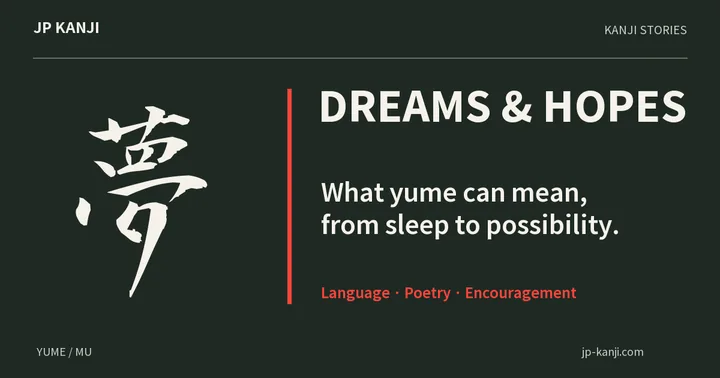
夢: the Japanese kanji for dreams, hopes and possibility

A dream can happen while you sleep or belong to a future you imagine. Explore 夢 through language, poetry and the thought of encouraging someone.

Read the story

Everyday stories

Draw a room with one impossible rule

Invent a space where one ordinary relationship changes. Use the rule consistently enough that a visitor can explore your imagined room.

Read the story
13 more stories

Everyday stories

Use a homemade prompt lottery to invent an unexpected idea

Pair an ordinary object with an action by chance. Treat the result as a short creative game, not a test of originality.

Read the story

Everyday stories

Write two futures for one small fictional decision

Branch an original scene at a clear choice and follow both consequences. Change the action while keeping the opening facts steady.

Read the story

Everyday stories

Make a one-evening exhibition of ideas you never had to finish

Give a few unrealized ideas a temporary place on a shelf. Celebrate their interest without turning the display into a promise to complete them.

Read the story

Everyday stories

Turn a remembered dream into a four-panel comic

Keep one strange transition from a dream and build four simple panels around it. Clear shapes can carry a scene without polished drawing.

Read the story

Everyday stories

A creative hobby does not have to become a side hustle

Decide what you want from a creative pastime before turning it into orders, posts or a second job. Leave room for making things just because you enjoy it.

Read the story

Everyday stories

How to ask for feedback before your idea is finished

Make an unfinished idea easier to discuss with one useful question, a small sample and a clear next decision.

Read the story

Sayings & idioms

The same trip, different expectations: what are we imagining?

Two friends look forward to the same weekend, but picture different days. An everyday conversation leads to the expression 同床異夢.

Read the story

Culture & objects

Hatsuyume: reading a New Year dream as an image, not a forecast

Fuji, a hawk and an aubergine make an unexpected trio. A museum print offers a way into Japan’s first-dream imagery.

Read the story

Style & making

Make a small version of the idea you keep describing

A paper mock-up can answer one question that another long explanation cannot. Decide what you need to learn first.

Read the story

Everyday stories

Returning to an old idea without returning to an old deadline

An unfinished story in a drawer may still interest you. Begin by finding what matters now, rather than recreating the original plan.

Read the story

Everyday stories

Why an unfinished story can stay with you

An open ending leaves a question active. Explore the difference between a deliberate invitation and a missing piece of information.

Read the story

Words & readings

Yume, muchū and musō: three words around 夢

A dream, being absorbed in something, and imagining possibilities are related ideas, not interchangeable translations.

Read the story

Giving & choosing

A 夢 gift that encourages a dream without adding pressure

For a new idea, a graduation or a creative restart: recognise what matters to them without demanding a result.

Read the story

Another character, another perspective

All stories →

Style & making

Finding your visual style by noticing what you repeat

Collect examples you genuinely return to, then describe their common details. A personal style can emerge from choices rather than a label.

Read the story

Everyday stories

Enjoy a small collection without needing the complete set

Give a collection a personal focus and a physical limit. Keep the details that matter, and leave room to pass on the next tempting object.

Read the story

Everyday stories

Make your creative notebook easier to find things in

Build a small index from the questions you actually ask when returning to old notes. Link different names for the same useful detail.

Read the story