EN · Language
EnglishDeutschFrançaisItalianoEspañol

Everyday stories yume / mu

A creative hobby does not have to become a side hustle

Decide what you want from a creative pastime before turning it into orders, posts or a second job. Leave room for making things just because you enjoy it.

Wear this character

Start with a scene

You show someone a small drawing and they say, “You could sell those.” It may be a kind compliment. It does not have to become your next task. Before opening a shop or promising commissions, ask what you currently like about drawing: experimenting, spending a quiet hour, giving something away or finishing an object. Selling could suit that enjoyment, or it could change the part you value most.

A closer look

Choose what the hobby is allowed to ask of you

Try describing a good session without referring to an audience. Perhaps you tested two colours, used a tool you already own or lost interest and stopped halfway through. Choose a practical limit that protects this freedom: one evening without posting, a materials budget you are comfortable with, or a notebook nobody else needs to see. These are personal choices, not a formula for becoming more productive later.

If you are curious about selling, separate one small experiment from the rest of the hobby. Decide in advance what you are offering, how much time you can give it and when you will review the experience. Keep a project that remains private. You can enjoy a paid experiment and still decide that packaging, messages or deadlines are not what you want to add to every weekend.

See it in words

夢
yumeA dream
夢を見る
yume o miruTo have a dream while sleeping; context matters
夢を持つ
yume o motsuTo hold a dream or aspiration
Examples of usage, not a diagram of the character’s historical development.

A meaning to make your own

A thought to give

For a creative friend, a note could say: “I love that you make room for this.” Avoid making the gift a prediction of future success. Let them choose whether their interest stays a pastime or becomes something else.

Make a gift card

One more question

Does keeping a hobby private mean I am not taking it seriously?

No. You can learn, practise and care about your work without publishing it. If sharing is enjoyable, choose the audience and timing that suit you. Public attention and personal commitment are different ways of relating to an activity.

A character to carry with you 夢

夢 can refer to a dream or an aspiration. Here the character belongs to the freedom to imagine a life you actually want, including interests that stay small or private. An aspiration does not need a customer, an audience or a business plan to matter.

Wear this character
夢

夢

Share this story

More about this character 夢

All stories →

Meaning & background

夢: the Japanese kanji for dreams, hopes and possibility

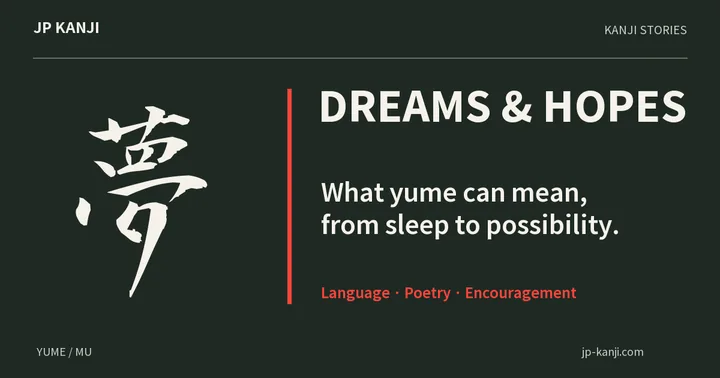
A dream can happen while you sleep or belong to a future you imagine. Explore 夢 through language, poetry and the thought of encouraging someone.

Read the story

Everyday stories

How to ask for feedback before your idea is finished

Make an unfinished idea easier to discuss with one useful question, a small sample and a clear next decision.

Read the story

Sayings & idioms

The same trip, different expectations: what are we imagining?

Two friends look forward to the same weekend, but picture different days. An everyday conversation leads to the expression 同床異夢.

Read the story

Culture & objects

Hatsuyume: reading a New Year dream as an image, not a forecast

Fuji, a hawk and an aubergine make an unexpected trio. A museum print offers a way into Japan’s first-dream imagery.

Read the story
6 more stories

Everyday stories

A notebook for ideas that are not ready yet

Catch a colour, a phrase or an unfinished question without turning every page into a project plan.

Read the story

Style & making

Make a small version of the idea you keep describing

A paper mock-up can answer one question that another long explanation cannot. Decide what you need to learn first.

Read the story

Everyday stories

Returning to an old idea without returning to an old deadline

An unfinished story in a drawer may still interest you. Begin by finding what matters now, rather than recreating the original plan.

Read the story

Everyday stories

Why an unfinished story can stay with you

An open ending leaves a question active. Explore the difference between a deliberate invitation and a missing piece of information.

Read the story

Words & readings

Yume, muchū and musō: three words around 夢

A dream, being absorbed in something, and imagining possibilities are related ideas, not interchangeable translations.

Read the story

Giving & choosing

A 夢 gift that encourages a dream without adding pressure

For a new idea, a graduation or a creative restart: recognise what matters to them without demanding a result.

Read the story

Another character, another perspective

All stories →

Style & making

Coordinated outfits without wearing the same clothes

Plan an outfit together around one shared detail while keeping your own colours, cuts and comfort. A practical idea for friends, partners or a group photo.

Read the story

Everyday stories

How to choose a meeting place that works for everyone

A useful meeting point needs more than a map pin. Share the entrance, the waiting spot and a simple plan for finding each other.

Read the story

Everyday stories

Make a travel playlist that remembers the journey in order

Turn a few songs into a personal route through a trip. Keep the connection specific with a place, a moment and one line of your own.

Read the story