Everyday stories tabi / ryo
Make a travel playlist that remembers the journey in order
Turn a few songs into a personal route through a trip. Keep the connection specific with a place, a moment and one line of your own.
Wear this characterStart with a scene
A journey playlist becomes more personal when each track has a reason for being there. Separate music you actually heard on the trip from music you connected with it later. Arrange the tracks around a few remembered moments, then add short captions in your own words. The sequence can tell a story without pretending every song played at the time.
A closer look
Choose the moment before choosing the song
Keep the first version short enough to hear in one sitting. Put the tracks in the order of the journey and write one original sentence beside each: where you were, what you noticed and why the sound belongs there for you. You do not need to reproduce lyrics. A brief note such as “The slow walk back after everything had closed” can carry more of your own experience than a copied verse.
If you share the playlist, use the music service’s supported sharing link and check what your friend can access. Keep private travel details out of a public description, and ask before including another person’s story. When listening while out, choose a time and place where you can still attend to your surroundings. A memory collection does not need to occupy every moment of the original trip.
Give five tracks five different moments
Use the blank plan below for a fictional trip from a station to a coastal town. Fill it with tracks you choose; the notes describe the selection rather than reproduce song lyrics.
Record what you remember accurately
For each track, note either “heard there” or “chosen later”. A later association is useful, but keep it distinct from a factual memory of a café or train journey.
Make the order travel somewhere
Start with departure, then movement, arrival, an unhurried stop and the return. Two tracks can belong to the same place if they give different parts of the story.
Share the route as well as the list
Add the title and artist alongside each original caption. Check that the playlist link opens for the intended listener; keep a written track list so the sequence remains understandable if their access differs.
1 — Station platform: [track / artist] — heard there or chosen later? 2 — View from the train: [track / artist] — what changed outside? 3 — First street in town: [track / artist] — what caught your attention? 4 — An unhurried stop: [track / artist] — one small remembered detail. 5 — Journey home: [track / artist] — what you carried back.
Read only the captions once. If all five say “a good memory”, replace one with a specific scene you can describe without quoting the song.
See it in words
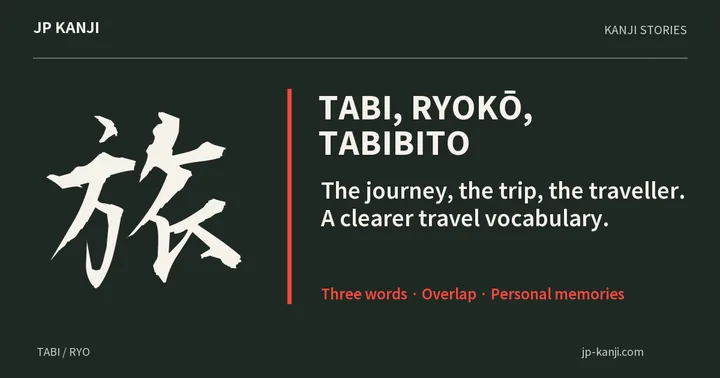
- 旅
- tabiA journey
- 旅行
- ryokōTravel; a trip
- 旅人
- tabibitoA traveller
A meaning to make your own
A thought to give
For a travel companion, pair the playlist with a note: “These are the moments I kept.” If you add a garment, let the character carry the shared journey while your own words identify the memories. The playlist can be a complete gift on its own.
Make a gift cardOne more question
What if we remember the trip differently?
Make room for both versions. Invite your companion to add one track and their own sentence, without correcting their memory to match yours. The result can be a conversation between two experiences rather than an official soundtrack.
A character to carry with you 旅
旅 can give that journey a simple visual association. If the recipient enjoys clothing with lettering, a Trip garment can accompany your playlist note. Choose their usual colour and fit and check the available options for their country; the meaning comes from the journey you share.
Find an available 旅 garment for a travel memory