EN · Language
EnglishDeutschFrançaisItalianoEspañol

Everyday stories ai

Lending a favourite object without leaving the important things unsaid

A book, jacket or small tool can carry personal meaning. Agree on its use and return so that sharing does not depend on guesswork.

Wear this character

Start with a scene

Someone admires a jacket you rarely wear, and you offer to lend it for an evening. Later you realise that you never discussed when it would come back or how it should be cleaned. Before handing over something you value, name the occasion and agree on a return plan. An ordinary, friendly conversation can do this: “Use it on Saturday, and bring it when we meet on Tuesday.”

A closer look

Make the offer as specific as the object

Explain any relevant practical detail without turning the exchange into a test. A book has a loose page; a tool needs its own charger; a garment has care instructions that should be checked before washing. Let the borrower decide whether they are comfortable with those conditions. If the object is irreplaceable or you would be distressed by ordinary wear, it may be kinder to keep it at home and offer a different way to help.

The person borrowing can make the arrangement easier too. Confirm the plan, ask before lending the item to somebody else, and mention a problem promptly instead of hoping it will go unnoticed. If the agreed return becomes inconvenient, suggest a new time before it passes. Specific plans leave less room for one person to treat an object casually while the other waits in silence.

See it in words

愛
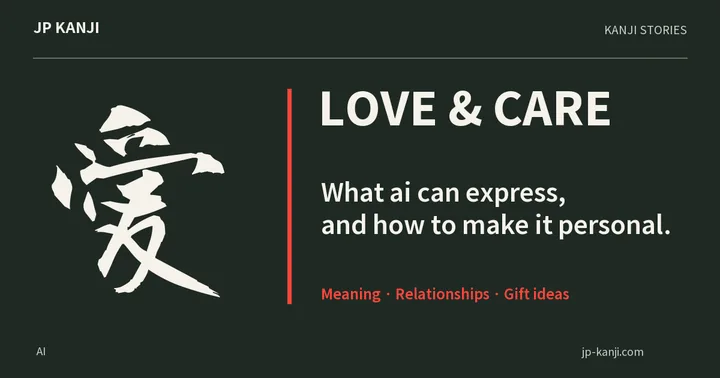
aiLove and care
恋
koiRomantic longing or love
恋愛
ren’aiRomantic love
Examples of usage, not a diagram of the character’s historical development.

A meaning to make your own

A thought to give

If you choose a gift inspired by 愛, a note might say: “I appreciate the care you take with the things that matter to me.” Mention the person rather than making the gift a reminder of a debt.

Make a gift card

One more question

Is it unkind to decline a request to borrow something?

You can decline without criticising the person asking. A brief explanation about the object may be enough. Offer an alternative only if you want to; a gift or a loan should not be the price of keeping a friendship comfortable.

A character to carry with you 愛

愛 means love and can also connect with the care we give people and cherished things. In this example, affection is expressed through a thoughtful offer and respect for its limits. Lending everything is not a requirement for being a caring friend.

Wear this character
愛

愛

Share this story

More about this character 愛

All stories →

Everyday stories

The objects you keep reaching for

A familiar cup, notebook or garment can hold a history of use. Find the detail that makes one ordinary object matter.

Read the story

Meaning & background

愛 and 恋: choosing the Japanese kanji for love

愛 is a character for love and care. Compare it with 恋, then find a way to give the design without relying on an unexplained symbol.

Read the story

Giving & choosing

Give clothing with room for a different size or colour

Choose a clothing gift without making the recipient defend their fit or taste. Agree on the useful details and leave a clear route for a change.

Read the story

Everyday stories

A birthday gift for someone who dislikes surprises

Make a birthday feel considered without a secret plan. Agree on the practical details and leave a small, personal part of the gift for the day itself.

Read the story
8 more stories

Everyday stories

A thoughtful gift starts with a detail you noticed

Move beyond guessing a personality: use a remembered preference to choose a gift that fits someone’s actual life.

Read the story

Sayings & idioms

Small acts of care, and four characters preserved in brushwork

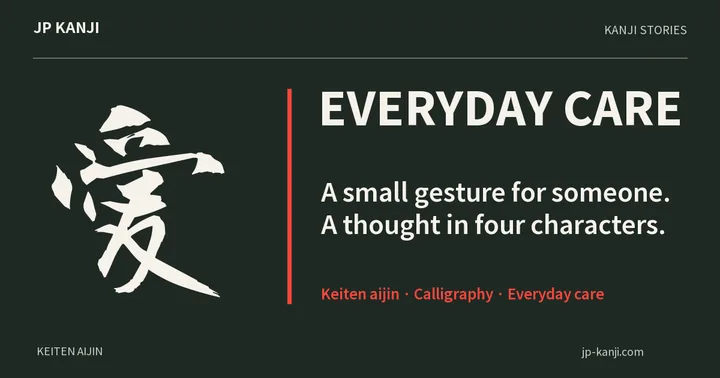
Making room for someone or letting them finish a thought: small gestures open a conversation about 敬天愛人 and a surviving work of calligraphy.

Read the story

Everyday stories

How to write a thank-you that could only be for one person

Name an action, its effect and the memory you kept. A few specific lines can carry more than a grand declaration.

Read the story

Everyday stories

Keeping a faraway friend in the ordinary parts of your life

A photograph of a familiar corner or a short postcard can offer something to share without demanding an immediate reply.

Read the story

Everyday stories

The handwritten recipe that holds more than ingredients

A margin note or a familiar abbreviation can preserve a person’s way of explaining. Keep the practical details and the memory together.

Read the story

Everyday stories

The small rituals that make an ordinary day feel shared

A cup set out or a familiar goodbye can mean something because of the people involved. Find out which gestures are actually welcome.

Read the story

Words & readings

Love beyond romance: aijō, aiyō and aichaku

Three words with 愛 reveal affection, favourite everyday objects and attachment built over time.

Read the story

Giving & choosing

Giving 愛 to a friend, a parent or a partner

Keep the same character and change the note: three ways to make a gift’s intention clear.

Read the story

Another character, another perspective

All stories →

Sayings & idioms

Getting along without agreeing on everything

A shared aim can leave room for different tastes. An everyday discussion leads to 和して同ぜず and the idea of keeping your own voice.

Read the story

Everyday stories

Sharing a space without needing the same habits

A small agreement about desks, noise and shared objects can make room for different ways of living.

Read the story

Style & making

Coordinated outfits without wearing the same clothes

Plan an outfit together around one shared detail while keeping your own colours, cuts and comfort. A practical idea for friends, partners or a group photo.

Read the story