EN · Language
English日本語DeutschFrançaisItalianoEspañol

Everyday stories ai

Keeping a faraway friend in the ordinary parts of your life

A photograph of a familiar corner or a short postcard can offer something to share without demanding an immediate reply.

Wear this character

Start with a scene

You see a shop window that would make a faraway friend laugh. Sending that small observation can be easier than waiting until you have enough news for a long catch-up. It gives the conversation a concrete place to begin whenever the other person has time.

A closer look

Send a piece of the day, not a performance

Choose a format that suits both of you: a picture with one sentence, a postcard, or a voice note they have said they enjoy. More messages do not automatically mean more care. A useful exchange leaves space for different schedules and for periods when neither person has much to report.

When you do speak, return to something they mentioned before. Asking how a drawing turned out can show that the earlier conversation stayed with you. Avoid turning the exchange into a score of who wrote last. If the rhythm is not working, talk about the rhythm directly instead of expecting every delayed reply to explain itself.

Send a small observation without a reply deadline

Try a photograph of a familiar shop with “They finally changed that crooked sign—thought you would enjoy it. No rush to reply.” Save a longer story for a call you both want. One clear subject gives the friend an easy way back into the conversation.

If messages repeatedly arrive at inconvenient times, agree on a different format or rhythm. Do not treat the last reply date as a score of who cares more.

Plan a birthday greeting across time zones without guessing the hour

See it in words

愛
aiLove and care
恋
koiRomantic longing or love
恋愛
ren’aiRomantic love
Examples of usage, not a diagram of the character’s historical development.

A meaning to make your own

A thought to give

“Different cities, still the first person I wanted to show this to.” Pair the message with an actual photo or memory you share.

Make a gift card

One more question

Does staying close require daily contact?

There is no single timetable for every friendship. Discuss what feels welcome to both people; frequency by itself does not tell the whole story of a relationship.

A character to carry with you 愛

愛 can recall an ordinary connection across distance. For a physical gift, confirm the person wants it and check the destination’s actual purchase options before arranging delivery.

Wear this character
愛

愛

Share this story

More about this character 愛
All stories →

Sayings & idioms

Keiten aijin: the Japanese maxim about reverence and care for others

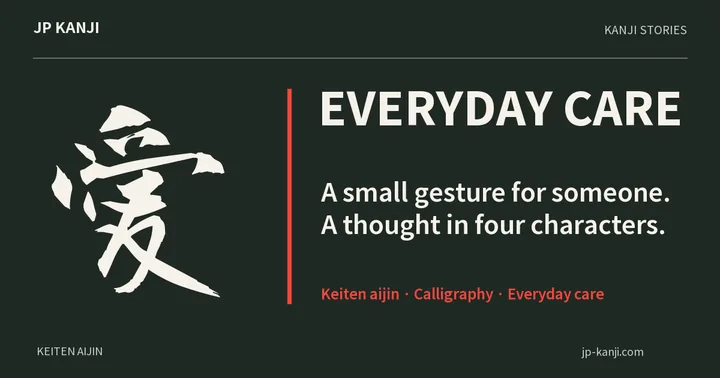
Making room for someone or letting them finish a thought: small gestures open a conversation about 敬天愛人 and a surviving work of calligraphy.

Read the story

Everyday stories

The small rituals that make an ordinary day feel shared

A cup set out or a familiar goodbye can mean something because of the people involved. Find out which gestures are actually welcome.

Read the story

Everyday stories

The handwritten recipe that holds more than ingredients

A margin note or a familiar abbreviation can preserve a person’s way of explaining. Keep the practical details and the memory together.

Read the story

Everyday stories

How to write a thank-you that could only be for one person

Name an action, its effect and the memory you kept. A few specific lines can carry more than a grand declaration.

Read the story
29 more stories

Everyday stories

Offer useful help without making a friend organise it all

Turn a vague offer into two practical choices, with a clear time and an easy way to decline. Start with what your friend actually wants.

Read the story

Everyday stories

Make a portrait with three questions instead of a camera

Invite someone to describe an ordinary pleasure, a surprising preference and a detail they want remembered. Let them shape the finished text.

Read the story

Giving & choosing

Build a small care parcel around a letter, not a pile of extras

Choose a few items that make sense together and let the message explain why they are there.

Read the story

Giving & choosing

Before giving a plant, check whether the recipient wants to care for it

Think about space, routine and household suitability before choosing a living gift.

Read the story

Giving & choosing

What to say when a thoughtful clothing gift does not fit

Thank the intention and make the practical problem easy to discuss.

Read the story

Giving & choosing

Write letters to open later without predicting someone's life

Choose occasions the recipient can recognise and give them control over the timing.

Read the story

Giving & choosing

How to make a small memory box without keeping everything

Choose a few objects with clear stories, add short notes and leave room for the person who will open the box. A meaningful collection can stay small.

Read the story

Meaning & background

愛 and 恋: choosing the Japanese kanji for love

愛 is a character for love and care. Compare it with 恋, then find a way to give the design without relying on an unexplained symbol.
Read the story

Giving & choosing

Make a matching game from personal photographs

Choose clear pairs, identical backs and pictures everyone is happy to share.

Read the story

Style & making

Make a friendship map that shows connections rather than precise addresses

Use shared places and clear labels to tell a personal story.

Read the story

Everyday stories

Write a recipe credit note that keeps the person's story attached

Distinguish who taught you, what you changed and what you still need to ask.

Read the story

Giving & choosing

Choose a gift for a pet lover that is actually for the person

Separate the owner’s tastes from the animal’s needs before choosing a portrait, keepsake or clothing.

Read the story

Giving & choosing

An experience gift for a grandparent: choose the day together

Plan around the person’s interests, pace and practical preferences instead of treating age as a gift category.

Read the story

Everyday stories

Plan an at-home date that feels different from an ordinary evening

Change the arrangement, choose one shared activity and agree on a simple ending instead of overproducing the night.

Read the story

Giving & choosing

Before turning a photograph into a gift, check who wants it displayed

Choose the image, audience and format together when a picture contains someone else’s private moment.

Read the story

Giving & choosing

Make a recorded voice message that feels like a gift, not a performance

Choose one memory, record clearly and make the message easy for the recipient to keep.

Read the story

Giving & choosing

Make a personal crossword from shared memories without making it impossible

Use fair clues, a readable grid and an answer key for a playful personal gift.

Read the story

Everyday stories

Choose a family photo location around the people who will be in it

Prioritise access, light and a workable meeting point before choosing a dramatic backdrop.

Read the story

Giving & choosing

A kanji anniversary gift: 愛, 和 or 旅 for your shared story

Choose an anniversary T-shirt or sweatshirt around affection, life together or a journey you remember. Compare three characters and write a note that makes the connection clear.

Read the story

Everyday stories

One photograph, two memories: write a caption together without agreeing on everything

Make a private keepsake from one shared photograph and two independent captions. Different memories can stay different on the same page.

Read the story

Everyday stories

Recommend a favourite book without giving your friend homework

Explain the connection behind a recommendation, offer a small starting point and leave space for a different response.

Read the story

Giving & choosing

Turn a running joke into a tiny book for two

Give a shared joke four illustrated pages: an origin, a variation, a surprise and a quiet closing detail. Keep its audience small by choice.

Read the story

Everyday stories

Lending a favourite object without leaving the important things unsaid

A book, jacket or small tool can carry personal meaning. Agree on its use and return so that sharing does not depend on guesswork.

Read the story

Giving & choosing

Give clothing with room for a different size or colour

Choose a clothing gift without making the recipient defend their fit or taste. Agree on the useful details and leave a clear route for a change.

Read the story

Everyday stories

A birthday gift for someone who dislikes surprises

Make a birthday feel considered without a secret plan. Agree on the practical details and leave a small, personal part of the gift for the day itself.

Read the story

Everyday stories

A thoughtful gift starts with a detail you noticed

Move beyond guessing a personality: use a remembered preference to choose a gift that fits someone’s actual life.

Read the story

Everyday stories

Why everyday objects become favourites: usefulness, habit and memory

A familiar cup, notebook or garment can hold a history of use. Find the detail that makes one ordinary object matter.

Read the story

Words & readings

Japanese words for love beyond romance: aijō, aiyō and aichaku

Three words with 愛 reveal affection, favourite everyday objects and attachment built over time.

Read the story

Giving & choosing

A Japanese love-symbol gift for a friend, parent or partner: choosing 愛

Keep the same character and change the note: three ways to make a gift’s intention clear.

Read the story

Another character, another perspective

All stories →

Culture & objects

What makes a shared meal feel shared?

Preparing, passing and clearing can matter as much as the menu. Washoku offers a cultural starting point for noticing those connections.

Read the story

Everyday stories

Prepare for an overnight guest when you do not have a spare room

Make sleeping space, belongings and the morning routine clear before your guest arrives.

Read the story

Style & making

Send a postcard from home as if someone were visiting your ordinary day

Choose one local detail and write a small scene instead of waiting for a holiday worth announcing.

Read the story