EN · Language
EnglishDeutschFrançaisItalianoEspañol

Everyday stories ai

Recommend a favourite book without giving your friend homework

Explain the connection behind a recommendation, offer a small starting point and leave space for a different response.

Wear this character

Start with a scene

You finish a novel and immediately think of a friend. Sending “You have to read this” is tempting, especially when the book gave you something you want to share. Before writing, name the actual connection. Did a conversation about buildings remind you of its setting, or does its dry humour resemble a film you both enjoyed? One precise reason makes a better invitation than a promise that the friend will love every page.

A closer look

Share why you thought of them, not what they must feel

Give a little context without explaining away the experience. Mention the form, the element you enjoyed and anything you already know they prefer to avoid, without guessing at personal sensitivities. If they want a starting point, suggest reading the publisher's description or trying a sample that is available to them. Do not send a long chain of supporting recommendations before they have expressed interest in the first one.

Leave the recommendation where an invitation belongs. You might say, “The description of the old cinema made me think of our conversation; no need to report back.” If your friend tries the book and dislikes it, ask which part did not work only if they want to discuss it. Their response does not cancel your enjoyment. You can learn that the feature you loved was exactly what made the book difficult for them.

See it in words

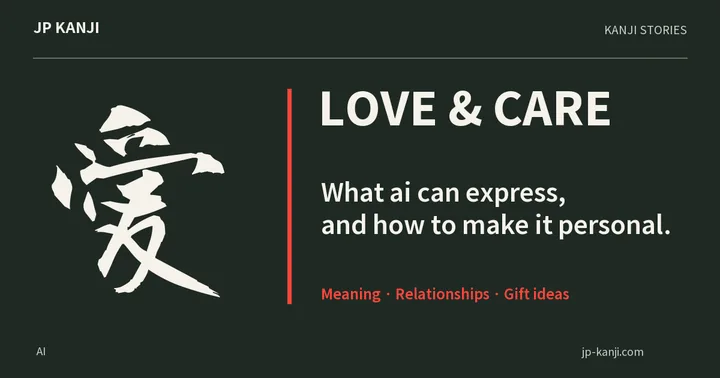
愛
aiLove and care
恋
koiRomantic longing or love
恋愛
ren’aiRomantic love
Examples of usage, not a diagram of the character’s historical development.

A meaning to make your own

A thought to give

If an 愛 design accompanies a book, explain why you chose both. Let the recipient keep their own reading pace, and avoid turning the next meeting into a progress check.

Make a gift card

One more question

What if I want to talk about the book together?

Ask directly whether they would enjoy that. Agreeing to a shared read is different from receiving a recommendation. Choose the book and timing together, including room to stop or change the plan if it is not enjoyable.

A character to carry with you 愛

愛 means love, including forms of affection beyond romance. Here it connects with sharing an enthusiasm while respecting the person receiving it. A shared interest can hold different opinions; agreement is not the price of admission.

Wear this character
愛

愛

Share this story

More about this character 愛

All stories →

Everyday stories

Lending a favourite object without leaving the important things unsaid

A book, jacket or small tool can carry personal meaning. Agree on its use and return so that sharing does not depend on guesswork.

Read the story

Meaning & background

愛 and 恋: choosing the Japanese kanji for love

愛 is a character for love and care. Compare it with 恋, then find a way to give the design without relying on an unexplained symbol.

Read the story

Everyday stories

One photograph, two memories: write a caption together without agreeing on everything

Make a private keepsake from one shared photograph and two independent captions. Different memories can stay different on the same page.

Read the story

Everyday stories

Offer useful help without making a friend organise it all

Turn a vague offer into two practical choices, with a clear time and an easy way to decline. Start with what your friend actually wants.

Read the story
13 more stories

Giving & choosing

Turn a running joke into a tiny book for two

Give a shared joke four illustrated pages: an origin, a variation, a surprise and a quiet closing detail. Keep its audience small by choice.

Read the story

Everyday stories

Make a portrait with three questions instead of a camera

Invite someone to describe an ordinary pleasure, a surprising preference and a detail they want remembered. Let them shape the finished text.

Read the story

Giving & choosing

Give clothing with room for a different size or colour

Choose a clothing gift without making the recipient defend their fit or taste. Agree on the useful details and leave a clear route for a change.

Read the story

Everyday stories

A birthday gift for someone who dislikes surprises

Make a birthday feel considered without a secret plan. Agree on the practical details and leave a small, personal part of the gift for the day itself.

Read the story

Everyday stories

A thoughtful gift starts with a detail you noticed

Move beyond guessing a personality: use a remembered preference to choose a gift that fits someone’s actual life.

Read the story

Sayings & idioms

Small acts of care, and four characters preserved in brushwork

Making room for someone or letting them finish a thought: small gestures open a conversation about 敬天愛人 and a surviving work of calligraphy.

Read the story

Everyday stories

The objects you keep reaching for

A familiar cup, notebook or garment can hold a history of use. Find the detail that makes one ordinary object matter.

Read the story

Everyday stories

How to write a thank-you that could only be for one person

Name an action, its effect and the memory you kept. A few specific lines can carry more than a grand declaration.

Read the story

Everyday stories

Keeping a faraway friend in the ordinary parts of your life

A photograph of a familiar corner or a short postcard can offer something to share without demanding an immediate reply.

Read the story

Everyday stories

The handwritten recipe that holds more than ingredients

A margin note or a familiar abbreviation can preserve a person’s way of explaining. Keep the practical details and the memory together.

Read the story

Everyday stories

The small rituals that make an ordinary day feel shared

A cup set out or a familiar goodbye can mean something because of the people involved. Find out which gestures are actually welcome.

Read the story

Words & readings

Love beyond romance: aijō, aiyō and aichaku

Three words with 愛 reveal affection, favourite everyday objects and attachment built over time.

Read the story

Giving & choosing

Giving 愛 to a friend, a parent or a partner

Keep the same character and change the note: three ways to make a gift’s intention clear.

Read the story

Another character, another perspective

All stories →

Sayings & idioms

Getting along without agreeing on everything

A shared aim can leave room for different tastes. An everyday discussion leads to 和して同ぜず and the idea of keeping your own voice.

Read the story

Everyday stories

Sharing a space without needing the same habits

A small agreement about desks, noise and shared objects can make room for different ways of living.

Read the story

Style & making

Coordinated outfits without wearing the same clothes

Plan an outfit together around one shared detail while keeping your own colours, cuts and comfort. A practical idea for friends, partners or a group photo.

Read the story