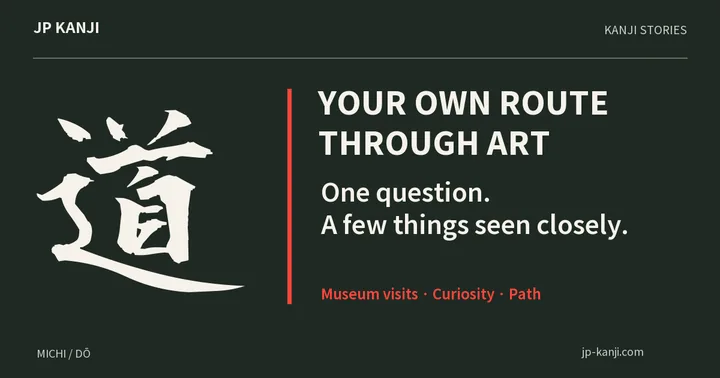
Everyday stories michi / dō
Plan a themed walk with three stops, not a checklist of sights
Choose a shared question for three nearby stops and give each one a different role.
Wear this characterThe short answer
A themed walk starts with a question rather than a list of famous places. You might look for three different uses of a colour, three shopfront lettering styles or three public artworks. Choose a small area and only places you may legitimately enter or observe.
A closer look
Curate the stops before writing directions
Give each stop a role: introduce the theme, show a contrast, then leave a question. Write one observation prompt for each, such as “Which detail makes this lettering feel older?” Avoid repeating the same description at every stop. Remove a place if it adds only distance.
Sketch the route with a clear start and finish, then check distances, crossings and any opening times. Offer a two-stop version and somewhere to pause. Do not describe a route as suitable for every access need without verifying the relevant conditions.
See it in words
- 道
- michiA road or path
- 書道
- shodōCalligraphy
- 柔道
- jūdōJudo
A meaning to make your own
A thought to give
For a walking companion, a 道 design can recall a route you shared. Choose a suitable everyday garment and check its real fit; the graphic itself says nothing about outdoor performance.
Make a gift cardOne more question
How many stops should I include?
Start with a few that belong together and test the actual route. Add more only if they improve the visit. A short walk with clear directions is usually more useful than a long list connected by rushed or confusing transfers.
A character to carry with you 道
道 means way or road. A route becomes more welcoming when it helps another person make their own decisions. The character can represent that attention to the journey rather than a requirement to follow every planned stop.
Wear this character