EN · Language
English日本語DeutschFrançaisItalianoEspañol

Everyday stories tabi / ryo

Travelling with a friend when your ideal days are different

Agree on pace, spending and time apart before a trip, so shared memories do not require an identical itinerary.

Wear this character

Start with a scene

One of you wants an early museum visit; the other imagines a slow breakfast and a long afternoon outside. These are two possible holidays, not evidence that you chose the wrong companion. Before booking the smaller details, each name one thing you would regret missing and one thing you are happy to leave open. Compare priorities before building a timetable.

A closer look

Plan the meeting points, too

Discuss the practical differences explicitly: spending limits, how much walking is comfortable, when you like to eat and which reservations are already fixed. If one person does the booking, agree on the budget and cancellation terms before they pay. A shared document with addresses and meeting times can help both people take part, rather than making one friend the permanent guide.

Leave a few periods that can be spent separately. Pick a clear place and time to meet again and decide what happens if plans change. You might visit different exhibitions and come back with two stories for dinner. Where local conditions make separating impractical, choose a smaller shared plan instead. Flexibility works best when nobody is left wondering where the other person has gone.

See it in words

旅
tabiA journey
旅行
ryokōTravel; a trip
旅人
tabibitoA traveller
Examples of usage, not a diagram of the character’s historical development.

A meaning to make your own

A thought to give

After a trip, attach a note to a gift with one exact memory: “For the café where our two afternoons met again.” Choose the memory you both recognise, rather than a slogan about being perfect travel partners.

Make a gift card

One more question

Is spending time apart a sign that the trip is going badly?

Not necessarily. If both people are comfortable with the arrangement and practical details are clear, it can be an intentional part of travelling together. Check in rather than assuming agreement, and keep essential safety and access needs ahead of the idea of a perfectly flexible trip.

A character to carry with you 旅

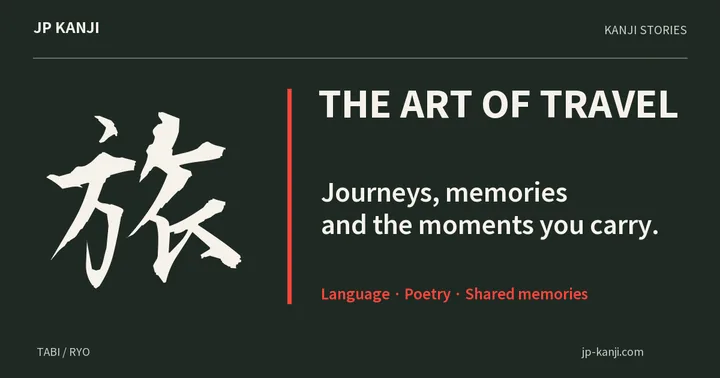
旅 means travel or journey. In this story, its personal meaning includes the space between two people’s preferred routes. A good shared trip need not erase either person’s way of looking; it can give you something new to tell each other.

Wear this character

旅

旅

Share this story

More about this character 旅

All stories →

Meaning & background

旅: tabi, travel and the stories you bring home

旅 is the kanji for a journey. Explore how a place can become a memory, and how to turn a travel-inspired design into a personal gift.

Read the story

Sayings & idioms

Remembering the journey, and the people who made it easier

An improvised lunch can stay with you longer than a missed train. A story of companionship leads to 旅は道連れ世は情け.

Read the story

Everyday stories

The small souvenir that remembers a whole afternoon

A ticket, postcard or sketch can carry a precise moment. Keep the memory attached before the object becomes anonymous.

Read the story

Everyday stories

Spending time on one street instead of collecting more stops

Choose a small area and a few questions. A modest outing can give you something specific to remember without a crowded itinerary.

Read the story
5 more stories

Style & making

A travel journal you can write in five lines

Record one place, one detail, one exchange, one surprise and one question. Keep it small enough to finish while the day is still clear.

Read the story

Everyday stories

The return journey: noticing home after being away

A familiar room can look slightly different when you return. Record the difference before ordinary routines cover it again.

Read the story

Everyday stories

Giving a travel memory to someone who was not there

A souvenir becomes easier to receive when its story connects with the recipient, not only with the traveller.

Read the story

Words & readings

Tabi, ryokō and tabibito: three Japanese travel words

A journey, travelling and a traveller: learn the differences without turning them into a rigid “tourist versus explorer” rule.

Read the story

Giving & choosing

A 旅 gift for a travel companion: turn one memory into a note

Choose a detail from a shared journey instead of a generic list of destinations or a promise of the next trip.

Read the story

Another character, another perspective

All stories →

Everyday stories

How to decide when a small project is done

Define a useful finish line before polishing forever. Progress can mean completing, handing over and making room.

Read the story

Everyday stories

Sharing a space without needing the same habits

A small agreement about desks, noise and shared objects can make room for different ways of living.

Read the story

Everyday stories

Choosing a first teacher: questions worth asking

Before committing to lessons, look at how a teacher explains a first step, responds to questions and fits your purpose.

Read the story