EN · Language
EnglishDeutschFrançaisItalianoEspañol

Everyday stories ryū / tatsu

Invent a dragon character with something more interesting than power

Give a fictional dragon a desire, a limitation and a habit. Use an ordinary encounter to discover what your character actually does.

Wear this character

Start with a scene

A dragon can fill a page with impressive wings and still give a story nowhere to go. Before drawing every scale, decide what this particular creature wants. Perhaps it collects the sounds of bells, wishes to cross a narrow bridge, or wants a gardener to stay for tea. Choose a desire that can meet a specific obstacle rather than a general mission to become the strongest.

A closer look

Let the limitation create the scene

Now add a limitation that changes its choices. The bell collector cannot distinguish one note from another; the enormous visitor cannot enter the greenhouse. These are inventions for your own story, so they need not follow an existing fantasy world. Ask what the creature tries when its usual strength does not help. A request, a mistake or an improvised tool can reveal more personality than a list of abilities.

Give it one repeatable habit: it straightens every crooked sign, counts its cups twice, or pretends not to enjoy compliments. Write a short encounter in which the habit appears without being explained. Let another character respond differently from what the dragon expects. You can sketch the moment, describe it in a paragraph or use it as the beginning of a tabletop adventure with friends.

See it in words

龍
ryū / tatsuThe fuller form used in our design
竜
ryū / tatsuAnother Japanese form for dragon
龍神
ryūjinA dragon deity
Examples of usage, not a diagram of the character’s historical development.

A meaning to make your own

A thought to give

For a fantasy-loving friend, include a note about the creature they imagined or the story you enjoyed together. A specific memory is more personal than declaring that a dragon design describes their entire character.

Make a gift card

One more question

Does my invented dragon need to follow Japanese folklore?

An original fantasy creature can follow the rules you choose. If you describe it as part of a particular tradition, research that tradition separately and distinguish recorded details from your additions. A kanji label alone does not establish a cultural origin.

A character to carry with you 龍

龍 means dragon. On a garment, the character can be a compact connection with your interest in imagined creatures, including the ones you create yourself. The personal story belongs to you; the word does not prescribe a single personality for every dragon.

Wear this character
龍

龍

Share this story

More about this character 龍

All stories →

Meaning & background

Dragon kanji: 龍, 竜 and the presence of a single character

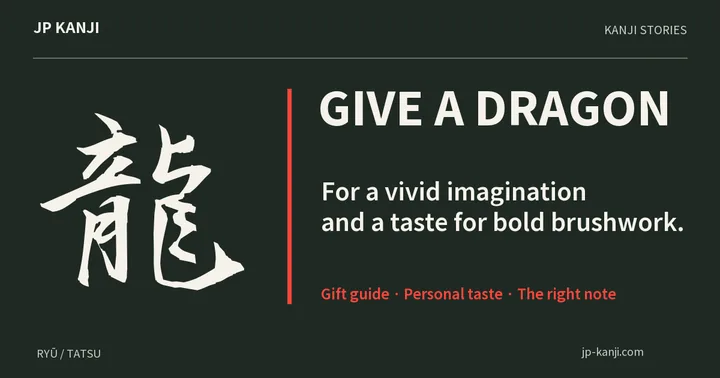
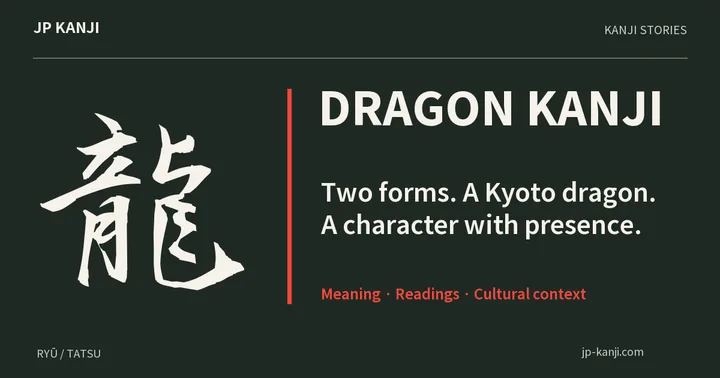
龍 means dragon. Discover its relationship with 竜, a dragon painted on a Kyoto temple ceiling, and a personal way to wear the character.

Read the story

Words & readings

Ryū or tatsu? How to read the Japanese dragon kanji

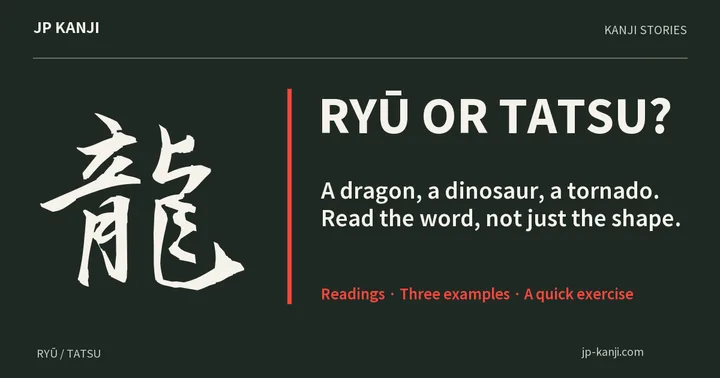
Learn the reading with the word: a dragon, a dinosaur and a tornado offer three useful starting points.

Read the story

Culture & objects

Tatsu, 辰 and 龍: choosing a dragon for a birth-year connection

A calendar and a dragon print may use different characters. Here is how to keep a personal birth-year gift clear.

Read the story

Style & making

Choosing a brush-lettered kanji shirt: look beyond the silhouette

Look at the character, its small spaces and its place on the garment before choosing a brush-lettered design. Three views can answer different questions.

Read the story
7 more stories

Everyday stories

What does your kanji shirt say? A simple answer that feels like you

Explain a Japanese character in three steps: its meaning, its reading and the reason you chose it. A conversation can stay short and accurate.

Read the story

Everyday stories

Quiet confidence: what to say when you enter a new room

A practical way to introduce yourself without performing a louder version of your personality—and a dragon to carry the thought.

Read the story

Sayings & idioms

Garyō tensei: the dragon and the finishing touch

Why would a painted dragon need one final detail? Explore 画竜点睛 and the difference between finishing a piece and adding more to it.

Read the story

Style & making

Why bold lettering needs room around it

Try a simple framing exercise with a dense character: the blank area can change how clearly you see the whole design.

Read the story

Everyday stories

Showing your work for the first time, without a grand announcement

One print on a table and one useful question can make a first showing feel concrete. The dragon comes at the end of the story.

Read the story

Style & making

How to build an outfit around one bold graphic

Start with clothes you already wear. Compare layers, texture and contrast before adding more statement pieces.

Read the story

Giving & choosing

A dragon kanji gift for someone who loves a bold design

Choose 龍 for the person’s taste, then turn a familiar fantasy motif into a personal message.

Read the story

Another character, another perspective

All stories →

Culture & objects

Giving the unseen a figure: thinking about wind gods in art

An invisible force can become a character in a picture. Start with a named artwork, then separate its record from your own response.

Read the story

Everyday stories

Why an unfinished story can stay with you

An open ending leaves a question active. Explore the difference between a deliberate invitation and a missing piece of information.

Read the story

Everyday stories

Turn a remembered dream into a four-panel comic

Keep one strange transition from a dream and build four simple panels around it. Clear shapes can carry a scene without polished drawing.

Read the story