EN · Language
EnglishDeutschFrançaisItalianoEspañol

Everyday stories yume / mu

Plan an indoor treasure hunt with clues people can actually follow

Test the route, the hiding places and the final reveal before inviting players.

Wear this character

Start with a scene

For a small indoor treasure hunt, choose the final hiding place first and work backwards through four or five clues. Use rooms and objects you have permission to include. Keep private drawers, fragile displays and places requiring climbing outside the route.

A closer look

Write the route backwards from the ending

Give each clue one clear destination. ‘Where we keep the blue mugs’ is testable; ‘where memories live’ may point to half the house. You can add playful wording after the destination is unambiguous. Number the backs of the clues so you can restore the order if they are found early.

Walk the route exactly as a player would, reading only the clue currently available. Check that a later envelope cannot be seen from an earlier stop. Prepare a small hint for each step and agree that asking for one is part of playing, not a failure.

See it in words

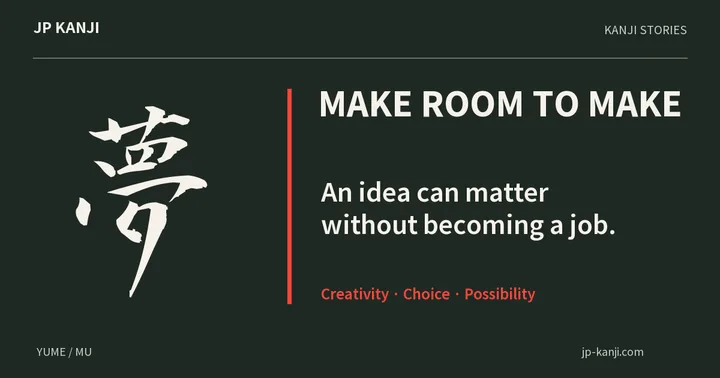
夢
yumeA dream
夢を見る
yume o miruTo have a dream while sleeping; context matters
夢を持つ
yume o motsuTo hold a dream or aspiration
Examples of usage, not a diagram of the character’s historical development.

A meaning to make your own

A thought to give

If the treasure is clothing, keep the fitting choice open. A card revealing the design can end the hunt without committing the recipient to an unconfirmed size.

Make a gift card

One more question

What if people read at different speeds?

Let one person read aloud or use picture clues that you have tested. Adjust the format to the participants rather than making speed the condition for taking part.

A character to carry with you 夢

夢 means dream. A dream motif can suit a hunt through imagined places, while the practical route remains clear enough for real people to enjoy.

Wear this character

夢

夢

Share this story

More about this character 夢
All stories →

Sayings & idioms

The same trip, different expectations: what are we imagining?

Two friends look forward to the same weekend, but picture different days. An everyday conversation leads to the expression 同床異夢.

Read the story

Everyday stories

A bookshop date with conversation built into the browsing

Use a few light prompts to explore each other’s tastes without turning the visit into a test or a shopping challenge.

Read the story

Meaning & background

夢: the Japanese kanji for dreams, hopes and possibility

A dream can happen while you sleep or belong to a future you imagine. Explore 夢 through language, poetry and the thought of encouraging someone.

Read the story

Style & making

Plan a short film with a six-shot storyboard

Turn one small event into a sequence you can actually film.

Read the story
30 more stories

Style & making

Write an imaginary café menu that suggests a whole world

Use a few names, descriptions and consistent details to build a fictional place.

Read the story

Style & making

Make an illustrated calendar for one month without filling every square

Keep the dates useful and give the drawing a separate place to breathe.

Read the story

Style & making

Design a playlist cover that still reads at thumbnail size

Choose one visual idea and test it where listeners will actually see it.

Read the story

Everyday stories

Plan a creative afternoon on your own without buying a new hobby

Choose one place, one small activity and a comfortable stopping point for time spent following your curiosity.

Read the story

Style & making

Start a reading journal without writing a review of every book

Keep the details you will want later: what you read, where an idea appears and what stayed with you.

Read the story

Giving & choosing

Make a birthday wish list that gives people useful choices

Share specific preferences, varied prices and non-object ideas without turning the list into an obligation.

Read the story

Giving & choosing

A gift for someone starting a hobby: buy the next useful thing

Check what the beginner wants to try before buying a large kit, specialist tool or ongoing subscription.

Read the story

Style & making

What to put on the first page of a new sketchbook

Use the opening page to learn about the paper instead of making it your best drawing.

Read the story

Style & making

Make a one-minute audio story from a place you imagine

Build a short spoken scene around one change the listener can follow.

Read the story

Giving & choosing

Giving a creative class as a gift: leave the date and difficulty open

Check the real booking conditions before presenting an experience someone has to schedule.

Read the story

Style & making

Make a two-sided bookmark with a different small scene on each side

Keep the construction flat and test it in a spare book before giving it away.

Read the story

Everyday stories

Write a short creative bio when you are just beginning

Describe what you make and what interests you without inventing a professional history.

Read the story

Giving & choosing

A kanji graduation gift: choose between dreams, progress and a new path

Compare 夢, 進 and 道 for a graduation gift, with messages that celebrate the graduate without choosing their future for them.

Read the story

Giving & choosing

Gifts for someone who loves writing: choose around their real habits

A useful writer’s gift starts with how they write, not a stereotype of an author’s desk. Compare familiar tools, a wanted book, time together and a personal design.

Read the story

Everyday stories

Write a postcard from an ordinary afternoon you would like to have

Imagine the small details of a possible future day, then ask which details actually matter to you. Keep the exercise separate from a promise or deadline.

Read the story

Everyday stories

Draw a room with one impossible rule

Invent a space where one ordinary relationship changes. Use the rule consistently enough that a visitor can explore your imagined room.

Read the story

Everyday stories

Use a homemade prompt lottery to invent an unexpected idea

Pair an ordinary object with an action by chance. Treat the result as a short creative game, not a test of originality.

Read the story

Everyday stories

Write two futures for one small fictional decision

Branch an original scene at a clear choice and follow both consequences. Change the action while keeping the opening facts steady.

Read the story

Everyday stories

Make a one-evening exhibition of ideas you never had to finish

Give a few unrealized ideas a temporary place on a shelf. Celebrate their interest without turning the display into a promise to complete them.

Read the story

Everyday stories

Turn a crowded inspiration folder into a mood board you can use

Choose a small set of references for one creative question. Add reasons, keep source links and make the next experiment clear.

Read the story

Everyday stories

Turn a remembered dream into a four-panel comic

Keep one strange transition from a dream and build four simple panels around it. Clear shapes can carry a scene without polished drawing.

Read the story

Everyday stories

A creative hobby does not have to become a side hustle

Decide what you want from a creative pastime before turning it into orders, posts or a second job. Leave room for making things just because you enjoy it.

Read the story

Everyday stories

How to ask for feedback before your idea is finished

Make an unfinished idea easier to discuss with one useful question, a small sample and a clear next decision.

Read the story

Culture & objects

Hatsuyume: reading a New Year dream as an image, not a forecast

Fuji, a hawk and an aubergine make an unexpected trio. A museum print offers a way into Japan’s first-dream imagery.

Read the story

Everyday stories

A notebook for ideas that are not ready yet

Catch a colour, a phrase or an unfinished question without turning every page into a project plan.

Read the story

Style & making

Make a small version of the idea you keep describing

A paper mock-up can answer one question that another long explanation cannot. Decide what you need to learn first.

Read the story

Everyday stories

Returning to an old idea without returning to an old deadline

An unfinished story in a drawer may still interest you. Begin by finding what matters now, rather than recreating the original plan.

Read the story

Everyday stories

Why an unfinished story can stay with you

An open ending leaves a question active. Explore the difference between a deliberate invitation and a missing piece of information.

Read the story

Words & readings

Yume, muchū and musō: Japanese words for dreams and imagination

A dream, being absorbed in something, and imagining possibilities are related ideas, not interchangeable translations.

Read the story

Giving & choosing

A meaningful gift to encourage someone’s dreams: choosing 夢

For a new idea, a graduation or a creative restart: recognise what matters to them without demanding a result.

Read the story

Another character, another perspective

All stories →

Everyday stories

Travelling with a friend when your ideal days are different

Agree on pace, spending and time apart before a trip, so shared memories do not require an identical itinerary.

Read the story

Everyday stories

When a shared plan changes: making the new version clear

A changed time or cancelled contribution can leave people imagining different plans. Write the next agreement in plain language.

Read the story

Everyday stories

When the picnic becomes an indoor afternoon

A changed plan can preserve the part people were looking forward to. Identify that part before replacing the whole day.

Read the story