EN · Language
EnglishDeutschFrançaisItalianoEspañol

Everyday stories wa / nagomu

Write a shared event caption without speaking for everyone

Separate the facts from personal reactions, then check names and images together. A group memory does not need a single compulsory voice.

Wear this character

Start with a scene

A group photograph is ready, and someone types “We all had the best evening”. Perhaps they did; perhaps one person was tired and another arrived only for the final hour. A shared caption can begin with facts everyone recognises: where you met, what you made or what the picture shows. “Our first printmaking afternoon, with six very different postcards” gives the event a clear identity without assigning a feeling to every person.

A closer look

Share the account, leave room for different reactions

Invite short individual additions if the group wants them. One person may mention a stubborn ink mark; another may enjoy the unexpectedly bright result. Attribute reactions when that makes the distinction useful. You do not have to combine every sentence into an artificially uniform voice. At the same time, leave private conversations and jokes out unless the people involved actually want them shared with that audience.

Check the proposed image, names, tags and text with the people concerned before publishing. Agreement to attend an event is not the same as wanting a recognisable photograph or account link online. Make corrections in the saved final caption, not only in a message that the next person posting may miss. If you cannot agree on a public version, a private record or no post can be a complete outcome.

See it in words

平和
heiwaPeace
調和
chōwaHarmony or balance
和食
washokuJapanese food culture
Examples of usage, not a diagram of the character’s historical development.

A meaning to make your own

A thought to give

A 和 gift might include a printed caption both of you chose for a favourite photograph. Keep it private if that is the agreed setting. The care lies in the accurate shared memory, not in how widely it is posted.

Make a gift card

One more question

Does everyone have to write part of the caption?

No. One person can draft it and others can check how they are represented. Someone may prefer to approve a factual line, remove their name or stay out of the post entirely. Participation does not require equal word counts.

A character to carry with you 和

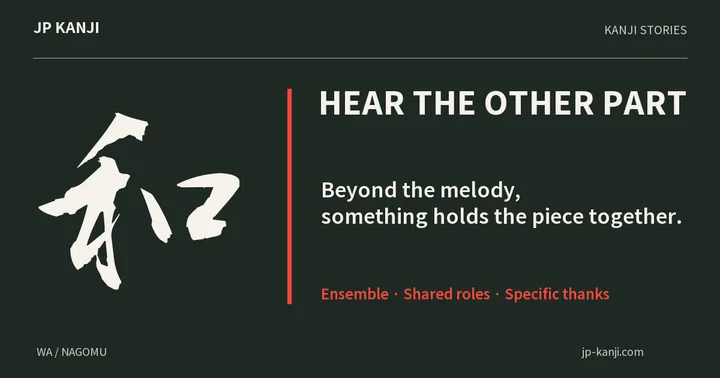
和 can express harmony. For this situation, it connects with an account that holds different experiences without pretending they were identical. A design with the character can recall a particular shared day, while each person keeps their own memory of it.

Wear this character
和

和

Share this story

More about this character 和

All stories →

Everyday stories

Making room for the quieter person in a conversation

A welcoming gathering needs more than extra chairs. Small changes can make it easier for different people to join in.

Read the story

Everyday stories

Why the quieter part matters in an ensemble

A melody may stand out while another part makes it possible. Use a simple listening exercise to notice the work around the centre.

Read the story

Everyday stories

Write credits for a shared creative project before you forget the details

Make the work around a finished project visible: agree on names, describe contributions and check the credit line together before publication.

Read the story

Meaning & background

和: harmony, Japanese culture and room for one another

和 appears in words for peace, harmony and Japanese food. See how context changes its meaning and how it can become a thoughtful gift.

Read the story
13 more stories

Everyday stories

Start a board-game evening with a practice turn, not a test

Make the first round understandable and agree on the practical rules before competition begins. Different levels of experience can share the same table.

Read the story

Everyday stories

Make a two-person playlist that leaves room for both tastes

Alternate a few song choices for an ordinary listening session. The aim is to share attention, not to prove whose music belongs in the room.

Read the story

Everyday stories

Set up a shared creative toolkit people can actually return things to

Give each tool a clear home and make unfinished use visible. A small borrowing system can prevent the repeated mystery of the missing scissors.

Read the story

Everyday stories

Make one small invitation work in two languages

Give the practical information equal visibility and ask a reader to check each version. A welcoming invitation begins with details people can actually use.

Read the story

Everyday stories

Plan a small clothing swap where nobody feels obliged to take something

Make a clothing swap easier with clear expectations, honest condition notes and a plan for items that do not find a new owner.

Read the story

Style & making

Coordinated outfits without wearing the same clothes

Plan an outfit together around one shared detail while keeping your own colours, cuts and comfort. A practical idea for friends, partners or a group photo.

Read the story

Everyday stories

Sharing a space without needing the same habits

A small agreement about desks, noise and shared objects can make room for different ways of living.

Read the story

Sayings & idioms

Getting along without agreeing on everything

A shared aim can leave room for different tastes. An everyday discussion leads to 和して同ぜず and the idea of keeping your own voice.

Read the story

Culture & objects

What makes a shared meal feel shared?

Preparing, passing and clearing can matter as much as the menu. Washoku offers a cultural starting point for noticing those connections.

Read the story

Style & making

A small colour palette that still feels like you

Try two colours and one accent using clothes or objects you already own. Harmony can include a deliberate difference.

Read the story

Everyday stories

When a shared plan changes: making the new version clear

A changed time or cancelled contribution can leave people imagining different plans. Write the next agreement in plain language.

Read the story

Words & readings

Wa in context: peace, harmony and Japanese clothing

Compare heiwa, chōwa and wafuku to see why 和 cannot always be translated as “peace”.

Read the story

Giving & choosing

A 和 thank-you gift for the person who brings people together

Recognise a host, teammate or friend through one specific moment of care, without asking them to keep everyone happy.

Read the story

Another character, another perspective

All stories →

Everyday stories

Showing your work for the first time, without a grand announcement

One print on a table and one useful question can make a first showing feel concrete. The dragon comes at the end of the story.

Read the story

Everyday stories

How to ask for feedback before your idea is finished

Make an unfinished idea easier to discuss with one useful question, a small sample and a clear next decision.

Read the story

Style & making

Finishing a first version that someone can respond to

A usable draft needs a clear job. Decide what it should let another person see before polishing every corner.

Read the story