Style & making bi / utsukushii
Build a pattern from one small mark
A curve, dash or uneven dot can become a personal pattern. Compare spacing and direction before adding more shapes or colours.
Wear this characterStart with a scene
Make a small mark that you can repeat comfortably: a bent dash, an open oval or a short pair of lines. Draw it several times on scrap paper and keep the version that feels natural to make. You do not need identical copies. For this exercise, the repeating relationship matters more than a perfectly mechanical stamp.
A closer look
Keep the mark; change the rhythm
Divide a page into three areas. In the first, repeat the mark at fairly regular intervals. In the second, turn alternate marks. In the third, let the spacing gradually open up. Use the same pen so you can compare those decisions clearly. Check where your eye pauses, where rows seem to form and where two marks accidentally become a new shape.
Choose one area and interrupt it once. Leave a gap, reverse a mark or let one pair touch. Does the interruption look deliberate, or does it simply distract? Try the pattern as a small card border or a notebook cover before filling a larger sheet. A lively full page may become visually busy when reduced to a narrow strip.
See it in words
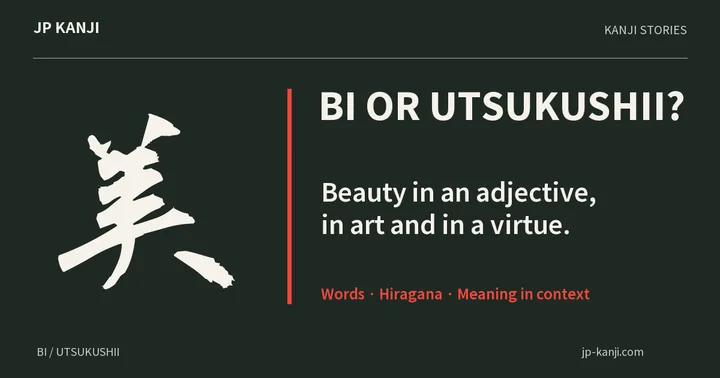
- 美
- biBeauty; read bi in many words
- 美しい
- utsukushiiBeautiful
- み
- miHiragana mi, historically linked to cursive 美
A meaning to make your own
A thought to give
Wrap a small 美 gift in your own patterned paper, leaving the printed character easy to see when the package opens. The repeated mark can carry a shared colour or doodle without pretending to be a traditional motif.
Make a gift cardOne more question
Should I copy a pattern I like?
Use it to identify a question, such as spacing or direction, then make your own marks. If you reproduce an existing design for a public or commercial project, check its permissions separately. This exercise does not require borrowing a recognisable pattern.
A character to carry with you 美
美 can connect with the pleasure of seeing a relationship emerge from modest marks. A single kanji on clothing works differently from a repeated pattern, but both invite you to notice how a shape occupies its space.
Wear this character