EN · Language
English日本語DeutschFrançaisItalianoEspañol

Style & making bi / utsukushii

The beautiful detail that makes something easier to use

A clear handle or a readable label can be pleasing because it helps. Look for a specific connection between appearance and use.

Wear this character

Start with a scene

A drawer looks tidy, yet its handle is difficult to find. Another has a small, clear grip that makes the action obvious. Comparing them suggests a useful question: which visual detail helps someone understand what to do next?

A closer look

Follow the hand and the eye

Choose an ordinary object and watch how you use it. Where does your hand go first? Which label do you read? Describe a detail that helps and one that interrupts. Keep the task specific; an object that suits one action may be awkward for another.

If you are designing something small, such as a printed invitation, test the useful information before adding decoration. Ask someone to find the date and place. Then adjust spacing or contrast and try again. A design can be expressive while making the reader’s task straightforward.

See it in words

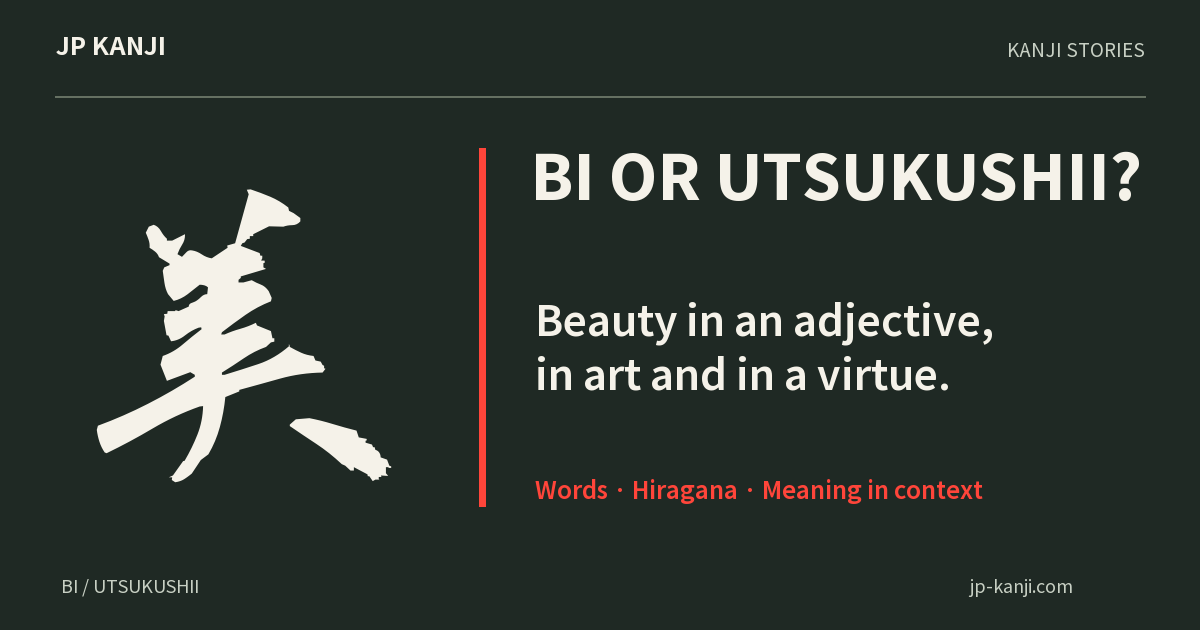
美
biBeauty; read bi in many words
美しい
utsukushiiBeautiful
み
miHiragana mi, historically linked to cursive 美
Examples of usage, not a diagram of the character’s historical development.

A meaning to make your own

A thought to give

“You thought about the person using it.” Mention the handle, page or arrangement that made you feel considered.

Make a gift card

One more question

Must useful design be plain?

No. Decoration can support recognition or enjoyment. Test whether it helps the actual task rather than assuming that either ornament or simplicity is automatically better.

A character to carry with you 美

美 includes beauty and excellence. For this theme, the character can stand for care that is both visible and useful, a personal interpretation grounded in a particular detail.

Wear this character
Share this story

More about this character 美

All stories →

Meaning & background

美: Japanese kanji for beauty, from a character to a way of looking

Discover 美, its relationship with the word utsukushii and the hiragana み, and a personal approach to choosing a design for beauty.

Read the story

Sayings & idioms

What makes a good ending?

After the final artwork or presentation, an impression remains. A thoughtful goodbye leads to 有終の美 and another way to think about beauty.

Read the story

Style & making

A still life made from three things already on your table

A cup, a folded cloth and a piece of fruit can become an exercise in attention. Change the arrangement before searching for better objects.

Read the story

Everyday stories

When a familiar object shows its history

A softened edge or a worn handle can make use visible. Describe the trace before deciding what story it tells.

Read the story
4 more stories

Everyday stories

Looking at the same artwork twice, with a different question

The first glance finds an impression; the second can find its cause. Try a short method for looking without needing a grand interpretation.

Read the story

Culture & objects

A tea bowl can be beautiful in more than one way

Rustic surfaces are only one part of tea ceramics. A museum account helps make room for contrast, selection and individual objects.

Read the story

Words & readings

Bi and utsukushii: using the Japanese character for beauty

See how 美 works in an adjective, the arts and a word for virtue, without treating the kanji alone as a complete sentence.

Read the story

Giving & choosing

A 美 gift that celebrates someone’s eye, not just their looks

For a maker, photographer or attentive friend, recognise the details they notice and the care they bring.

Read the story

Another character, another perspective

All stories →

Culture & objects

Beyond the costume: asking what historical ninja actually did

Begin with duties and sources rather than a single dramatic image. Information gathering offers one documented part of a much wider subject.

Read the story

Everyday stories

Starting a hobby again after a long gap

Begin with the activity as it fits your life now. A return does not need to recreate your former schedule.

Read the story

Style & making

Make a small version of the idea you keep describing

A paper mock-up can answer one question that another long explanation cannot. Decide what you need to learn first.

Read the story