EN · Language
English日本語DeutschFrançaisItalianoEspañol

Everyday stories susumu / shin

Practising one small skill without turning everything into a score

A narrow question can make a practice session easier to understand. Compare examples, then decide what to work on next.

Wear this character

Start with a scene

You want to improve your drawing, but that aim is too broad for one short session. Choose something you can observe: the angle of a cup handle or the spacing between two objects. A narrow focus gives the session a question it can actually answer.

A closer look

Name the part you are practising

Make an early example and keep it. Try the same task again after a little focused practice, under similar conditions if possible. Describe a visible difference rather than immediately assigning a number. The handle may be clearer even if the whole drawing is not yet what you want.

Use the comparison to choose one next exercise. If there is no clear difference, ask whether the task was specific enough or whether a different explanation would help. A single session cannot describe your entire ability, and a change in materials can make comparison less straightforward.

See it in words

進む
susumuTo move forward
進める
susumeruTo move something forward
前進
zenshinForward movement
Examples of usage, not a diagram of the character’s historical development.

A meaning to make your own

A thought to give

“I noticed how carefully you worked on that one detail.” Specific recognition gives the effort a shape without comparing the person with everyone else.

Make a gift card

One more question

Do I need a chart for this?

Only if it helps answer your question. A pair of dated examples and a short note may show more than a chart whose numbers have no clear meaning.

A character to carry with you 進

進 concerns moving ahead. You can connect it with a particular skill becoming clearer, without requiring every practice session to produce a larger score.

Wear this character
Share this story

More about this character 進

All stories →

Meaning & background

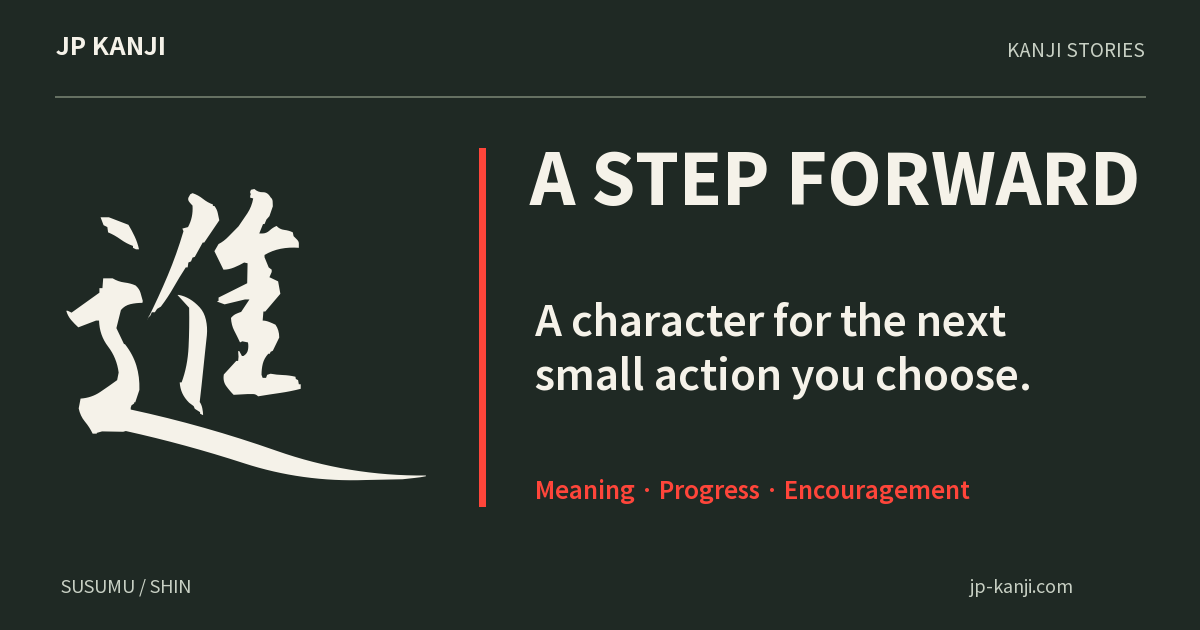
進: the Japanese kanji for moving forward, one step at a time

Learn how 進 appears in words about advancing, then find a way to make the character an encouraging reminder rather than a demand.

Read the story

Sayings & idioms

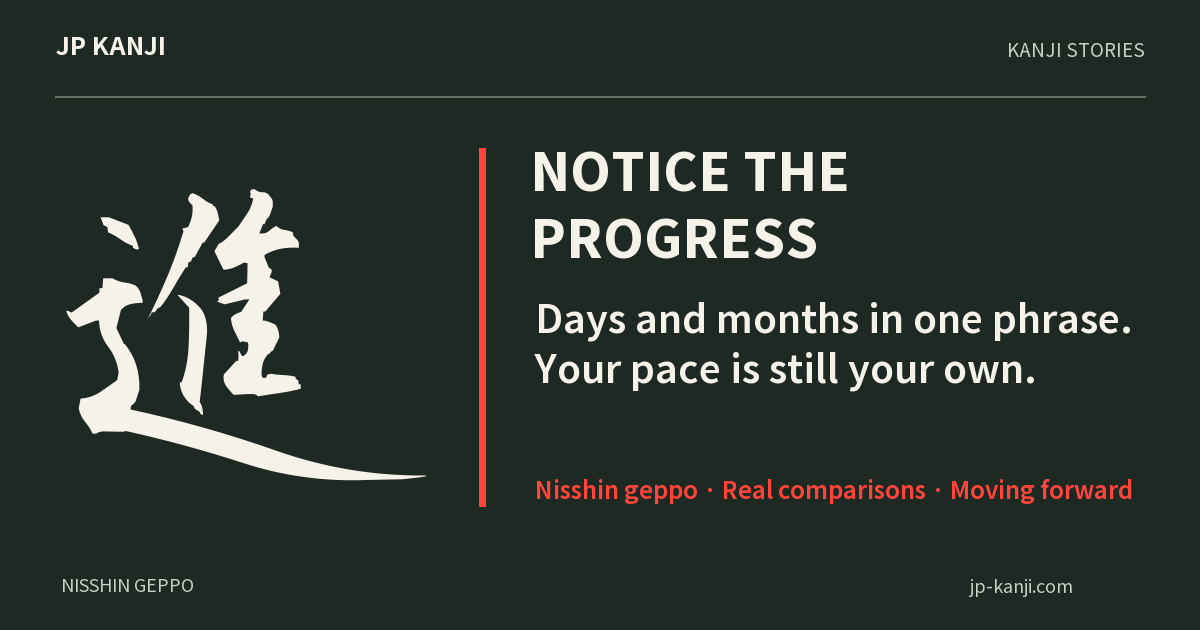
Nisshin geppo: reading 日進月歩 without turning it into a deadline

The expression describes continuing progress. Learn its rhythm, then distinguish a description of change from a demand to improve every day.

Read the story

Style & making

Finishing a first version that someone can respond to

A usable draft needs a clear job. Decide what it should let another person see before polishing every corner.

Read the story

Everyday stories

Starting a hobby again after a long gap

Begin with the activity as it fits your life now. A return does not need to recreate your former schedule.

Read the story
4 more stories

Everyday stories

Helping the next person continue where you stopped

A useful handover explains the current state, the next action and the unresolved questions. Progress can mean making continuation easier.

Read the story

Everyday stories

Learning with a friend without turning it into a race

Two people can work on different questions and still help each other. Make the purpose of feedback clear before comparing results.

Read the story

Words & readings

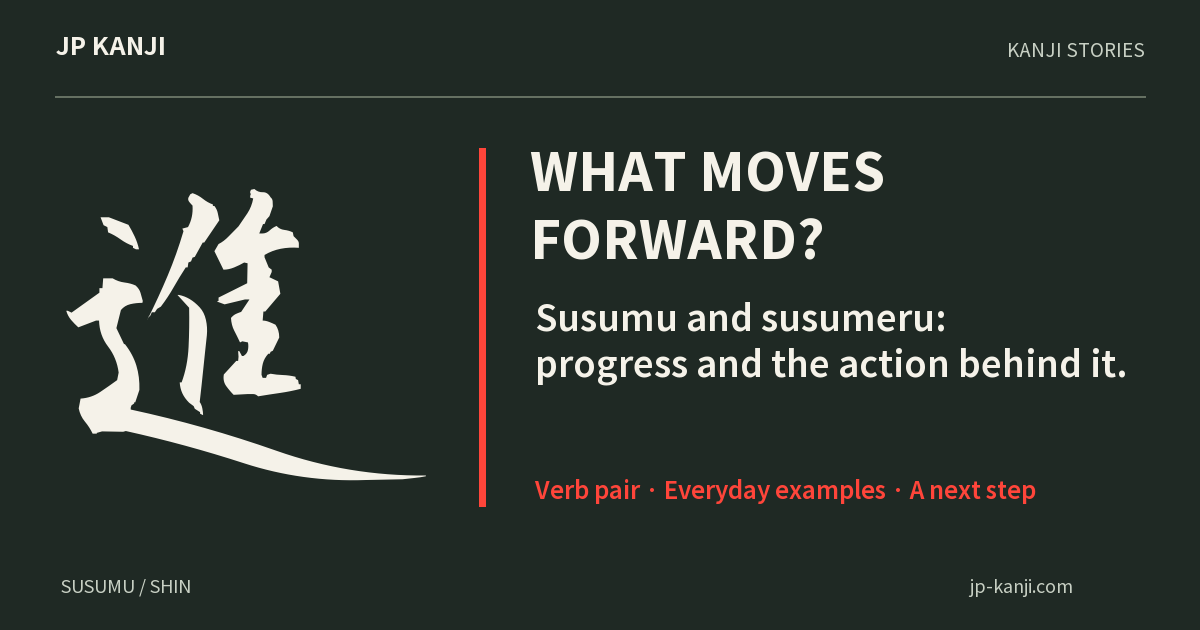
Susumu and susumeru: who is moving things forward?

Two verbs built from 進 place the focus differently. Learn the distinction with a meeting and a plan.

Read the story

Giving & choosing

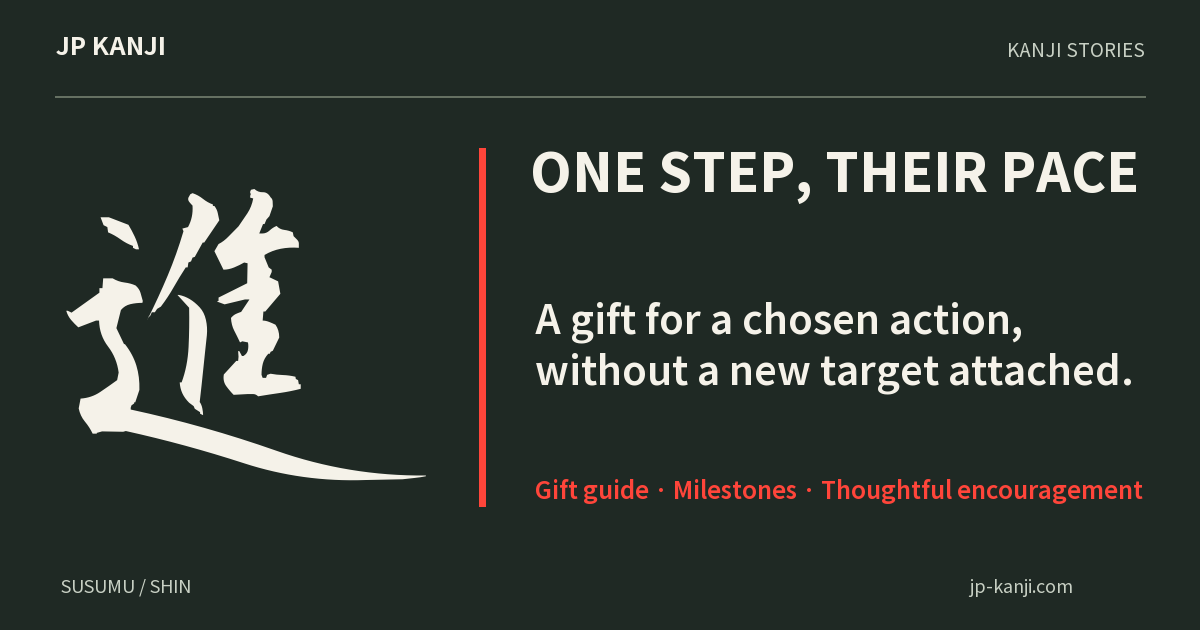
A 進 gift for a next step that belongs to them

Mark a launch, a return or a small achievement with encouragement that does not become a demand for speed.

Read the story

Another character, another perspective

All stories →

Culture & objects

Tatsu, 辰 and 龍: choosing a dragon for a birth-year connection

A calendar and a dragon print may use different characters. Here is how to keep a personal birth-year gift clear.

Read the story

Style & making

A small colour palette that still feels like you

Try two colours and one accent using clothes or objects you already own. Harmony can include a deliberate difference.

Read the story

Style & making

How to suggest wind in a still photograph

Show what the air touches: fabric, leaves or a reflection. Begin with visible evidence before inventing a story around it.

Read the story