EN · Language
English日本語DeutschFrançaisItalianoEspañol

Everyday stories tabi / ryo

The return journey: noticing home after being away

A familiar room can look slightly different when you return. Record the difference before ordinary routines cover it again.

Wear this character

Start with a scene

You come home and notice the sound of the door or the particular light near a window. These things were there before you left, but for a moment they stand out. The return can offer a scene worth remembering alongside the places you visited.

A closer look

The journey has a final scene

Write three short comparisons: something you missed, something you now appreciate differently, and something you would like to bring into an ordinary day. Keep the last one manageable. Enjoying a quiet breakfast elsewhere does not require rebuilding your entire home to keep a little of that experience.

Try one small continuation and see whether it suits your life at home. Display a photograph where you will actually see it, revisit a note, or make time to tell a companion one specific story. Some travel pleasures depend on their setting and can remain good memories without being reproduced.

See it in words

旅
tabiA journey
旅行
ryokōTravel; a trip
旅人
tabibitoA traveller
Examples of usage, not a diagram of the character’s historical development.

A meaning to make your own

A thought to give

“For the stories you brought home, and the ones still ahead.” Leave room for both the pleasure of travel and the pleasure of belonging somewhere.

Make a gift card

One more question

Does a trip need to transform my life?

No. A useful memory can be small. You can value a changed observation or a pleasant afternoon without turning the journey into a dramatic before-and-after story.

A character to carry with you 旅

旅 names a journey. The character can include coming back: the moment when a place you know becomes visible again through your own changed attention.

Wear this character


Share this story

More about this character 旅

All stories →

Meaning & background

旅: tabi, travel and the stories you bring home

旅 is the kanji for a journey. Explore how a place can become a memory, and how to turn a travel-inspired design into a personal gift.

Read the story

Sayings & idioms

Remembering the journey, and the people who made it easier

An improvised lunch can stay with you longer than a missed train. A story of companionship leads to 旅は道連れ世は情け.

Read the story

Everyday stories

The small souvenir that remembers a whole afternoon

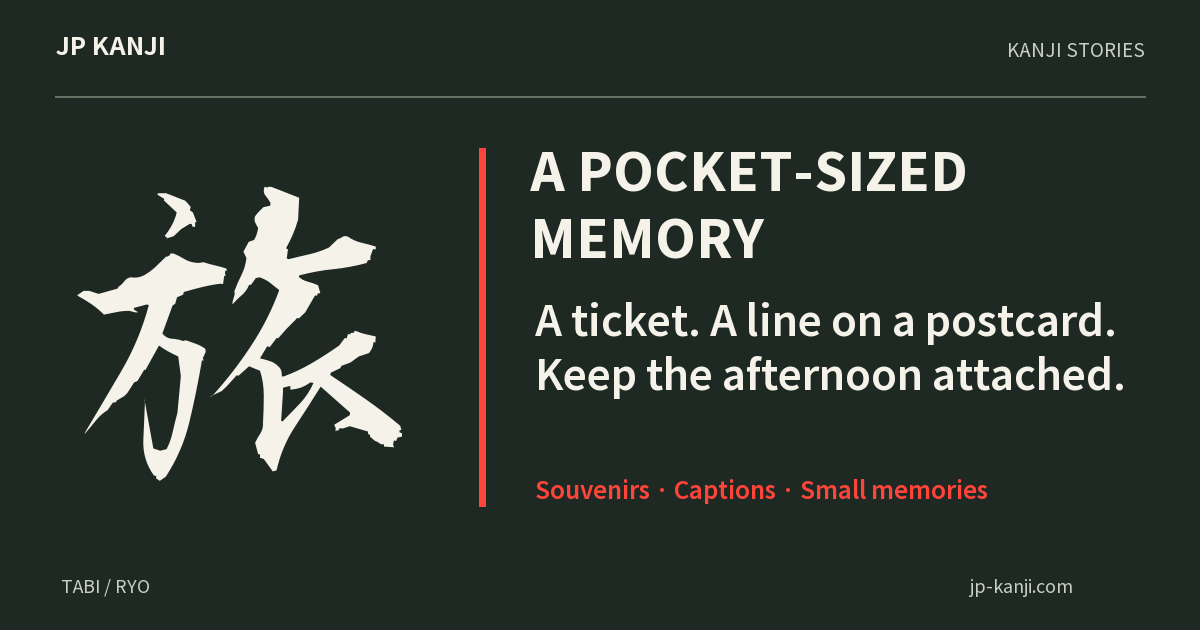
A ticket, postcard or sketch can carry a precise moment. Keep the memory attached before the object becomes anonymous.

Read the story

Everyday stories

Spending time on one street instead of collecting more stops

Choose a small area and a few questions. A modest outing can give you something specific to remember without a crowded itinerary.

Read the story
4 more stories

Style & making

A travel journal you can write in five lines

Record one place, one detail, one exchange, one surprise and one question. Keep it small enough to finish while the day is still clear.

Read the story

Everyday stories

Giving a travel memory to someone who was not there

A souvenir becomes easier to receive when its story connects with the recipient, not only with the traveller.

Read the story

Words & readings

Tabi, ryokō and tabibito: three Japanese travel words

A journey, travelling and a traveller: learn the differences without turning them into a rigid “tourist versus explorer” rule.

Read the story

Giving & choosing

A 旅 gift for a travel companion: turn one memory into a note

Choose a detail from a shared journey instead of a generic list of destinations or a promise of the next trip.

Read the story

Another character, another perspective

All stories →

Everyday stories

Helping the next person continue where you stopped

A useful handover explains the current state, the next action and the unresolved questions. Progress can mean making continuation easier.

Read the story

Everyday stories

Returning to an old idea without returning to an old deadline

An unfinished story in a drawer may still interest you. Begin by finding what matters now, rather than recreating the original plan.

Read the story

Everyday stories

The handwritten recipe that holds more than ingredients

A margin note or a familiar abbreviation can preserve a person’s way of explaining. Keep the practical details and the memory together.

Read the story